
In this article:
- Why This Turkey Gravy Thickens Every Single Time
- Deep Roast Flavor From a Two-Minute Roux
- Two Routes: Pan Drippings or Straight From the Pantry
- Ingredients for 15-Minute Turkey Gravy
- Roux, Warm Stock, Simmer: Gravy in Four Moves
- Five Fixes for Lumpy, Thin or Bland Gravy
- Gluten-Free and Lighter Turkey Gravy That Still Pours Silky
- Make It Three Days Ahead, Reheat It Silky
- The Boat Everyone Reaches For
- FAQ
Why This Turkey Gravy Thickens Every Single Time
Turkey gravy works when three quiet disciplines line up: a roux cooked long enough to lose its raw taste, stock that goes in warm, and a simmer measured in minutes rather than guesses. This recipe is built on exactly those three, in that order.
The warm stock matters more than any other single choice. Cold liquid hitting a hot roux seizes into lumps and steals five minutes of frantic whisking; warm stock pours in smooth and thickens almost on contact.
The second discipline is freedom. The recipe runs on two routes, one with pan drippings from the roasted bird and one with butter and stock alone, so the gravy can be finished before the turkey even leaves the oven, or days before it goes in.
Nothing here is fussy, and that is the point. A saucepan, a whisk and a quarter cup of flour stand between you and the single most requested sauce on the Thanksgiving table, ready in 15 minutes.
The proportions are worth memorizing because they scale to any holiday emergency: four tablespoons of fat, a quarter cup of flour, three cups of liquid. Double it for a crowd, halve it for a Tuesday chicken, and the method never changes. Ratio first, recipe second, and the sauce behaves every single time.
Turkey gravy is the sauce that decides whether the whole plate works. Dry turkey is forgiven the moment a glossy ladle of it lands, and even perfect mashed potatoes wait for it before anyone picks up a fork.
This version pours like satin and tastes like the roasting pan itself: deep, savory, faintly sweet from the browned flour, with thyme and sage kept low enough to support the bird rather than shout over it. It coats a spoon, a slice, and the back of your tongue in that order.
Make it while the bird rests and it is ready in 15 minutes; make it on Tuesday and Thanksgiving day loses its most stressful job. Either way, it belongs next to a properly juicy bird like our juicy turkey breast and a basket of 25-minute Thanksgiving dinner rolls for the swiping.
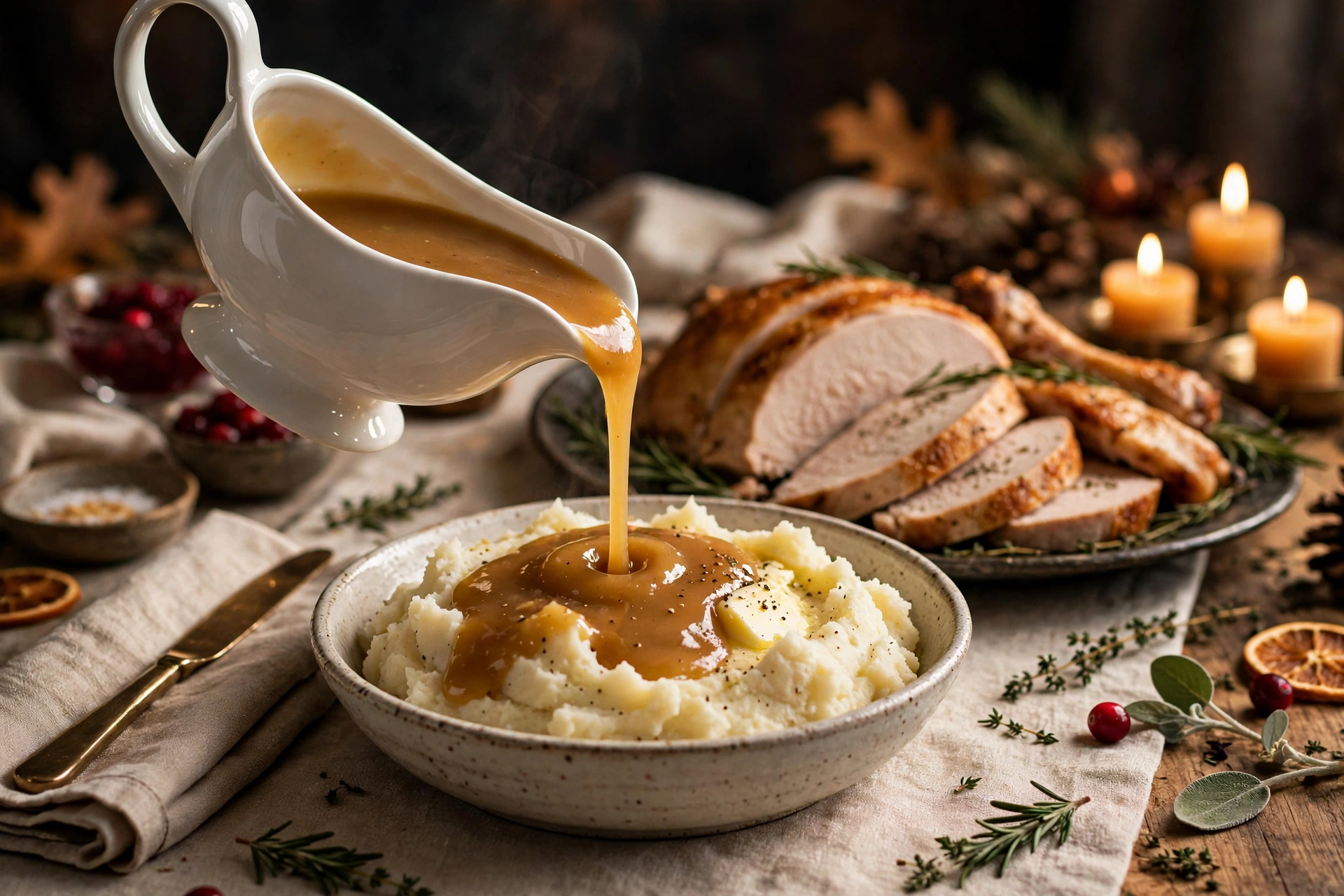
Deep Roast Flavor From a Two-Minute Roux
The flavor of this gravy is decided in the first two minutes, while the flour toasts in the butter. Raw flour tastes like paste and dulls everything it touches; flour cooked to a blond gold smells like hazelnuts and gives the sauce its roasted depth.
Watch the color, not just the clock. The roux should move from white to pale gold across the two minutes, foaming gently the whole time. A shade darker is fine and tastes even deeper; a shade past amber starts to bitter, so trust your nose.
The liquid brings the second layer. Drippings carry the true roast flavor of your specific bird, all the browned pan juices in concentrated form. Stock alone cannot fake that, which is why route one exists, but good stock plus a properly toasted roux gets remarkably close.
Herbs go in at the end, after the thickening, so their perfume survives. Thyme gives the savory backbone, sage adds the unmistakable Thanksgiving note, and black pepper should be fresh enough to make you look up. Salt waits for the final taste, because drippings and stock vary too much to season blind.
The finish is texture: glossy, slow, and just loose enough to pool on the plate rather than sit in a mound. A gravy that stands up is a gravy that needed one more splash of stock, and the fix takes ten seconds.
Sound gives the last clue. A ready gravy plops softly from the ladle in thick, slow drops, never a thin stream and never a solid slide. Once you have heard it once, you will start judging every gravy boat by ear before you ever lift a spoon.
Two Routes: Pan Drippings or Straight From the Pantry
Route one is the classic Thanksgiving day path. The turkey comes out, the drippings get strained and skimmed, and whatever dark juice you collect is topped up with warm stock to three cups total. Half a cup of drippings is plenty; the flavor is concentrated far beyond its volume.
Route two is the quiet revolution, and the one I use for make ahead batches. No bird, no drippings, no waiting: butter for the fat, a roux toasted one shade deeper for color, and warm turkey or chicken stock for the body. Nobody at the table has ever called it out.
The two routes merge at the roux and never diverge again, which means the timing, the thickening and the seasoning logic are identical. Learn one and you own both. This turkey gravy also happily accepts the resting juices from the carved platter at the last minute, whisked in for a final hit of roast flavor.
Choosing between them is purely a calendar question. Cooking for a Friendsgiving with a store bought rotisserie bird? Route two. Hosting the real day with a roasting pan full of treasure? Route one, and freeze any leftover drippings for the next batch.
A hybrid deserves mention, because it is what most experienced hosts actually do. Build route two on Tuesday when the kitchen is calm, then on Thursday whisk the finished gravy into the hot roasting pan for two minutes to pick up the fresh browned bits. All the calm of make ahead, all the flavor of the day itself, none of the panic.
Ingredients for 15-Minute Turkey Gravy
- 4 tablespoons (55 g) unsalted butter, or skimmed turkey fat from the drippings
- 1/4 cup (30 g) all-purpose flour
- 3 cups (720 ml) warm low-sodium turkey or chicken stock
- Up to 1/2 cup (120 ml) strained turkey pan drippings (optional, route one: reduce the stock to 2 1/2 cups)
- 1 teaspoon fresh thyme leaves, or 1/2 teaspoon dried thyme
- 1/2 teaspoon finely chopped fresh sage, or 1/4 teaspoon dried sage
- 1/2 teaspoon fine sea salt, plus more to taste
- 1/2 teaspoon black pepper
- 1 teaspoon lemon juice (optional, to brighten)
Roux, Warm Stock, Simmer: Gravy in Four Moves
Read the five steps once before you start, because the middle of this recipe moves quickly. Once the roux reaches its color, you will be pouring and whisking without a free hand, so the stock should already be warm, measured and standing beside the stove. That tiny bit of staging is the difference between a calm fifteen minutes and a scramble.
- Warm the stock in a small saucepan or in the microwave until steaming. Hot stock is your lump insurance, so do not skip this.
- Route check: if you are using drippings, strain them, skim off the fat, and top up with stock to 3 cups of liquid total. Melt the butter (or the skimmed turkey fat) in a medium saucepan over medium heat until foaming.
- Sprinkle in the flour and whisk it into a smooth paste. Cook the roux for exactly 2 minutes, whisking steadily, until blond gold and smelling nutty.
- Pour in the warm liquid in three additions, whisking hard after each one until completely smooth before adding the next. Bring to a gentle boil, then simmer 3 to 4 minutes, whisking often, until the gravy coats the back of a spoon and a finger drawn across leaves a clean trail.
- Stir in the thyme, sage, salt and pepper. Simmer 1 more minute, taste, add the lemon juice if you want brightness, and serve hot.
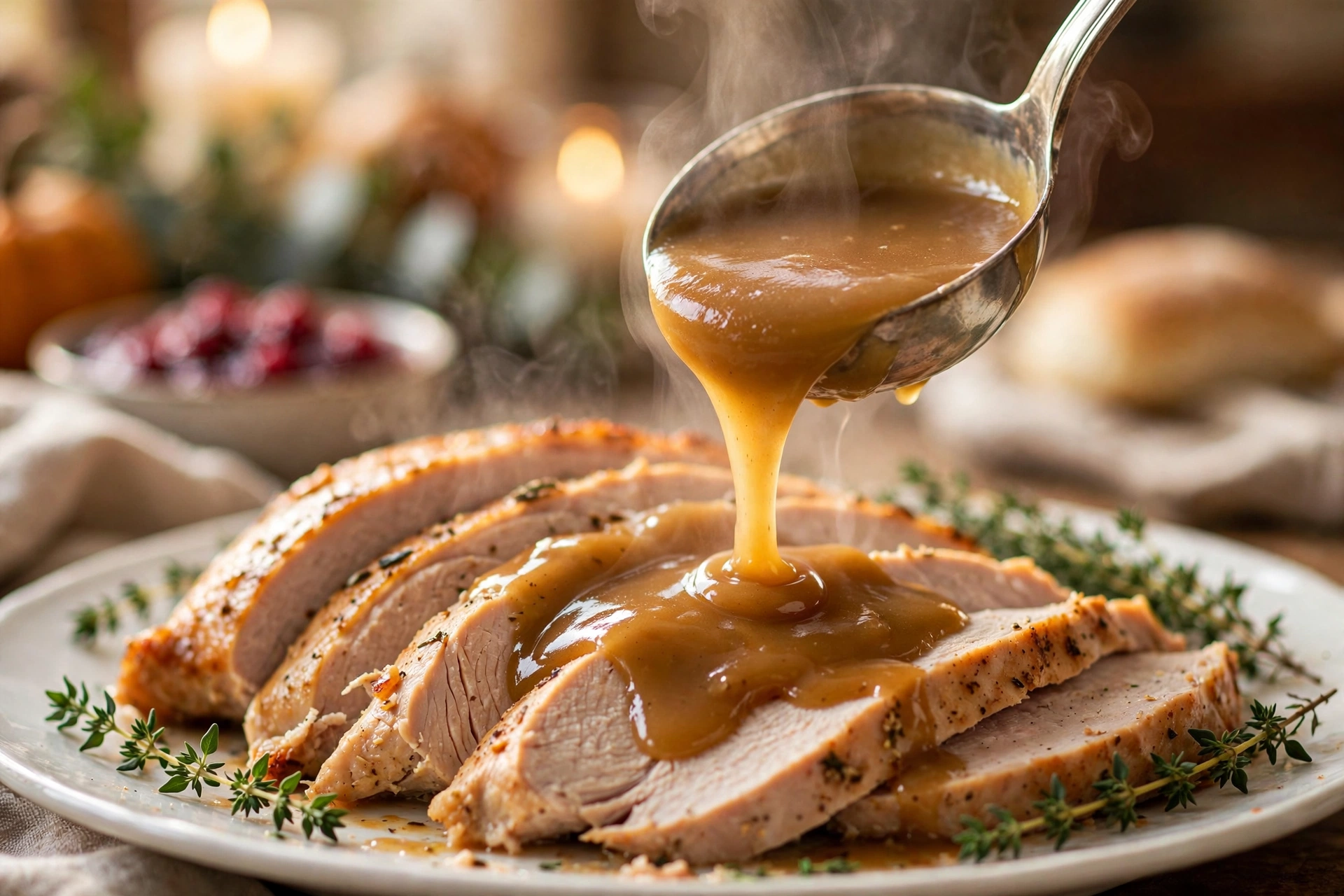
Five Fixes for Lumpy, Thin or Bland Gravy
Lumps mean the liquid went in cold or all at once. The rescue is mechanical: whisk hard for thirty seconds, and if the lumps persist, pour the gravy through a fine mesh sieve or give it five seconds with an immersion blender. It returns to silk every time.
Too thin is a patience problem, not an ingredient problem. Give it two more minutes of simmering before reaching for more flour, because a roux gravy thickens most at the end. If it is still loose, whisk a teaspoon of flour into a tablespoon of soft butter, then whisk that paste in and simmer one minute.
Too thick is the easiest fix on this page: whisk in warm stock a splash at a time until it pours in a slow ribbon. Judge it on the spoon, not in the pan, because gravy reads thicker while it bubbles than it eats on the plate.
Too salty happens when drippings are concentrated or the stock was salted. Whisk in a quarter cup of warm water or a splash of milk, then re-balance with a pinch of sugar if the edges still bite. Never add more flour to fix salt; it only makes more salty gravy.
Bland is a layering problem. First check salt, then add the lemon juice, then a pinch of garlic powder and an extra half teaspoon of thyme. Depth in this turkey gravy comes from the toasted roux, so if blandness keeps happening, your two minutes are running short.
A sixth rescue, for the gravy that broke or went greasy: the fat was never fully emulsified, usually because the liquid went in boiling hot over a screaming hot roux. Take the pan off the heat, whisk in two tablespoons of cold stock, and watch it pull back together. Return it to low heat and carry on.
Gluten-Free and Lighter Turkey Gravy That Still Pours Silky
For a gluten free batch, swap the flour for a gluten free all-purpose blend in the same quarter cup measure and keep the two minute roux. Blends brown a little faster than wheat flour, so pull the heat to medium-low for the second minute and watch the color.
A cornstarch route also works if a blend is not on hand: skip the roux, simmer the seasoned stock, and whisk in a slurry of two tablespoons of cornstarch with two tablespoons of cold water. It pours glossy and clear edged, though it reheats less gracefully than the roux version.
For a lighter pan, build route two with olive oil in place of butter and the leanest stock you have. The roux still forms, the gravy still thickens, and the flavor leans cleaner and more herb forward. Skim any fat that rises while it simmers and nobody will miss it.
Dairy free is simply route two with a neutral oil or dairy free butter. The method, the timing and the fixes all carry over unchanged.
One caution for every swap on this page: taste before the final salt in all of them. Blends, stocks and plant butters all carry different salt loads, and the gravy concentrates as it simmers. Season in the last minute, when the sauce in the pan is the sauce that will reach the table.
Make It Three Days Ahead, Reheat It Silky
Gravy is one of the great make ahead foods of the holiday. Cooked and cooled promptly, it keeps 3 days in the fridge in a sealed container, and its flavor deepens as the herbs settle into the sauce. Press wrap directly on the surface to prevent a skin.
Reheating is gentle or it is nothing: low heat, a whisk, and patience. The gravy will look thick and almost set when cold, then loosen as it warms. If it separates at first, keep whisking over the low heat and it comes back together; a splash of warm stock helps it along.
For longer storage, freeze it flat in zip bags for up to 3 months. Thaw overnight in the fridge, reheat slowly, and finish with the resting juices from the carved turkey for a just made taste. The USDA turkey basics for safe cooking are worth a skim before the big day, especially the resting times.
On the table, gravy waits for no one but cools for everyone. A small candle warmer or a preheated insulated boat keeps it pouring through second helpings, and it belongs within reach of the maple pecan mashed sweet potatoes and the skillet creamed corn.
Leftovers earn their keep all weekend. A spoonful turns leftover turkey and mashed potatoes into a hot open faced sandwich, loosens a too thick soup, and sauces a plate of buttered noodles better than anything from a jar. Freeze whatever survives Sunday in ice cube trays for instant pan sauce starters through December.
The Boat Everyone Reaches For
Turkey gravy asks for a toasted roux, warm stock and fifteen honest minutes, and in return it rescues dry slices, crowns the potatoes and silences the table for the first contented minute of the meal.
Pick your route, trust the two minute roux, and season at the very end when you can actually taste what the bird gave you. Tell me in the comments: drippings loyalist, or route two convert? Hanna
FAQ
How much turkey gravy should I plan per person?
This batch makes about 3 cups. Plan a generous 1/4 cup per person for the plate plus a little for seconds, so one batch covers 10 to 12 guests. For a crowd of gravy lovers, scale the recipe by half again and keep the same timings.
I have no drippings at all. Will butter and stock gravy really taste like turkey?
Yes, that is exactly what route two is built for. Toast the roux one shade deeper for color, use turkey stock if you can find it, and whisk in any resting juices from the carved platter at the end. The flavor lands savory and roasted, not bland.
Flour or cornstarch: which is better for turkey gravy?
Flour in a roux gives an opaque, classic gravy that reheats beautifully, which is why this recipe uses it. Cornstarch gives a glossier, more translucent sauce but thins as it sits and reheats poorly. For make ahead gravy, flour wins every time.
A skin formed on my gravy while it waited. How do I serve it smooth?
Whisk it over low heat with a spoonful of warm stock and the skin melts back in. To prevent it next time, cover the surface directly with wrap, keep the gravy over the lowest heat, or float a small knob of butter on top.
Can I freeze turkey gravy, and how do I reheat it?
Yes, freeze it flat in zip bags for up to 3 months. Thaw overnight in the fridge, then reheat slowly over low heat while whisking. It may look split at first, but it comes back together as it warms, especially with a splash of warm stock.
Turkey Gravy
Silky turkey gravy in 15 minutes, built on a 2 minute toasted roux and warm stock added in three additions. Two routes in one recipe: with strained pan drippings from the roasted bird, or with butter and stock alone, finished days ahead if you like. Thyme, sage and a final taste before salting keep it deep and balanced.
- Total Time: 15 minutes
- Yield: about 3 cups (12 servings of 1/4 cup) 1x
Ingredients
- 4 tablespoons (55 g) unsalted butter, or skimmed turkey fat from the drippings
- 1/4 cup (30 g) all-purpose flour
- 3 cups (720 ml) warm low-sodium turkey or chicken stock
- Up to 1/2 cup (120 ml) strained turkey pan drippings (optional, route one: reduce the stock to 2 1/2 cups)
- 1 teaspoon fresh thyme leaves, or 1/2 teaspoon dried thyme
- 1/2 teaspoon finely chopped fresh sage, or 1/4 teaspoon dried sage
- 1/2 teaspoon fine sea salt, plus more to taste
- 1/2 teaspoon black pepper
- 1 teaspoon lemon juice (optional, to brighten)
Instructions
- Warm the stock in a small saucepan or in the microwave until steaming. Hot stock is your lump insurance, so do not skip this.
- Route check: if you are using drippings, strain them, skim off the fat, and top up with stock to 3 cups of liquid total. Melt the butter (or the skimmed turkey fat) in a medium saucepan over medium heat until foaming.
- Sprinkle in the flour and whisk it into a smooth paste. Cook the roux for exactly 2 minutes, whisking steadily, until blond gold and smelling nutty.
- Pour in the warm liquid in three additions, whisking hard after each one until completely smooth before adding the next.
- Bring to a gentle boil, then simmer 3 to 4 minutes, whisking often, until the gravy coats the back of a spoon and a finger drawn across leaves a clean trail.
- Stir in the thyme, sage, salt and pepper. Simmer 1 more minute, taste, add the lemon juice if you want brightness, and serve hot.
- Prep Time: 5 minutes
- Cook Time: 10 minutes
6 commentaires sur « 15-Minute Turkey Gravy, With or Without Drippings »