
In this article:
- Why these garlic mashed potatoes honestly take 30 minutes
- The flavor payoff: nutty butter, soft garlic, clean potato
- Small cubes and a cold water start: the two habits behind the clock
- Ingredients
- Cooking and mashing the potatoes, step by step
- The dry minute that keeps them fluffy, never gluey
- Smooth or rustic: picking your mash texture
- Yukon, russet or red: potato swaps and a dairy free bowl
- Holding them warm through a long Thanksgiving
- Next day potatoes: patties, soup and pie tops
- Questions about these garlic mashed potatoes
These garlic mashed potatoes are the bowl I put on the Thanksgiving table when the turkey is resting, the gravy is spoken for, and the side dish still has to taste like somebody cared.
The potatoes are fluffy and pale gold, whipped around ribbons of brown butter, with garlic that tastes sweet and mellow instead of sharp. A shower of chives lands at the end, bright against all that richness.
The whole thing takes 30 minutes, and I mean the honest kind of 30 minutes: peeling, boiling, browning butter and mashing all counted, no steps hidden off the clock.
Most recipes for this dish cheat in one of two directions. They roast a whole head of garlic for 40 minutes before the potatoes even start, or they boil boulders for 25 minutes and call the total a guess.
This one takes a different route. The garlic perfumes the butter while it browns, which happens while the potatoes boil, and small cubes cut the cooking time in half.
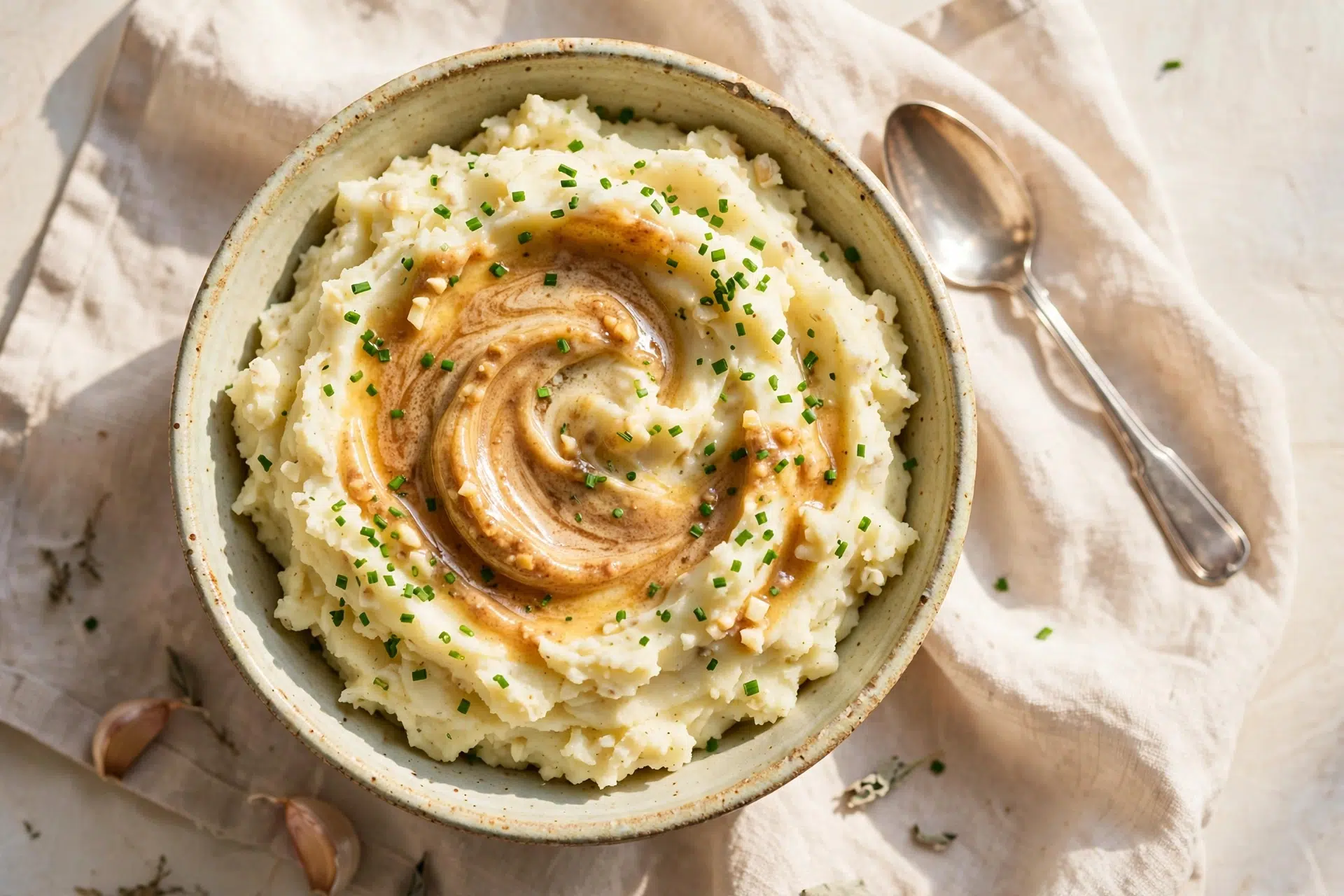
Why These Garlic Mashed Potatoes Honestly Take 30 Minutes
The clock works because nothing waits for anything else. The potatoes go into cold water the moment they are cubed, and while the pot climbs to a boil, your hands are free for the butter.
Small cubes are the first decision. A Yukon Gold cut into pieces of about 3/4 inch cooks tender in 12 minutes, where the big chunks in most recipes need 20 to 25. Same potato, same pot, half the wait.
The second decision is the garlic. Browning butter takes about 4 minutes over medium heat, and sliced garlic dropped into that butter for the last 30 seconds turns sweet and golden without a single minute in the oven.
Roasted garlic is lovely, and on a slow Sunday I roast it. But its flavor job here is background warmth, and garlic bloomed in brown butter does that job in the time the butter needs anyway.
The third decision is warm dairy. Milk and cream heated while the potatoes drain mean the mash never cools down and never needs extra beating to come back to temperature, which is where gluey texture usually sneaks in.
Add it up and the timeline reads clean: 8 minutes to peel and cube, 12 minutes at a boil with the butter browning in parallel, 1 minute of steam drying, and the rest is mashing and tasting.
The Flavor Payoff: Nutty Butter, Soft Garlic, Clean Potato
Brown butter changes mashed potatoes more than any other single move. Plain melted butter tastes rich and flat; butter cooked two minutes past melted tastes like toasted hazelnuts and warm toffee, and that depth rides through every bite.
The garlic follows the butter’s lead. Raw garlic in a mash reads harsh and a little green. The same garlic, sliced thin and bloomed in hot brown butter, turns mellow and almost sweet, seasoning the potatoes without announcing itself.
Keeping the potato flavor clean is the quiet third act. Yukon Golds bring their own buttery taste, so the dish needs less dairy than a russet mash and still lands creamy. Salt goes in the cooking water, where it seasons the cubes from the inside out.
The chives are not decoration. Their fresh, onion green bite cuts the richness at the exact moment the bowl starts to feel heavy, which is usually bite four.
Served in a warm bowl with brown butter pooled on top, this is the side that disappears while the turkey is still being carved.
Small Cubes and a Cold Water Start: The Two Habits Behind the Clock
Starting potatoes in cold water sounds like a detail for purists, but it is really a texture decision. Cubes dropped into boiling water seal their outsides and cook unevenly, so the edges slough off before the centers soften.
In cold water, the pot and the potatoes heat together. The cubes finish at the same moment, which matters when you have exactly 12 minutes and no patience for fishing out the stubborn ones.
Cut size matters just as much. Aim for pieces near 3/4 inch, roughly the size of a large dice. Much smaller and they waterlog; much bigger and the clock breaks.
Salt the water generously, about 1 tablespoon for a large pot. Potatoes absorb seasoning as they cook, and a mash salted only at the end always tastes like it is missing something you cannot name.
One more habit: keep the lid slightly ajar once the boil starts. A sealed pot of starchy water loves to foam over, and cleaning the stove is not part of the 30 minutes.
Ingredients
- 3 pounds Yukon Gold potatoes, peeled and cut into 3/4 inch cubes
- 1 tablespoon fine sea salt, for the cooking water, plus more to taste
- 8 tablespoons unsalted butter, divided
- 4 cloves garlic, thinly sliced
- 3/4 cup whole milk
- 1/4 cup heavy cream
- 1/2 teaspoon fine sea salt, for seasoning the mash
- 1/4 teaspoon black pepper
- 2 tablespoons finely snipped fresh chives, plus more to serve
- Flaky sea salt, to finish (optional)
Cooking and Mashing the Potatoes, Step by Step
- Put the potato cubes in a large pot, cover with cold water by 1 inch, and stir in the tablespoon of salt. Set over high heat and bring to a boil.
- Once boiling, reduce to a lively simmer and cook for 12 minutes, until a cube crushes easily against the side of the pot with a fork.
- While the potatoes cook, melt 6 tablespoons of the butter in a small skillet over medium heat. Swirl as it foams, then watch for the milk solids to turn amber and smell nutty, about 4 minutes.
- Drop the sliced garlic into the brown butter, swirl for 30 seconds until fragrant and just golden at the edges, then pull the skillet off the heat.
- Warm the milk and cream together in a small saucepan or a microwave safe jug until steaming, not boiling. Keep warm.
- Drain the potatoes in a colander, then return them to the hot empty pot over low heat for 1 minute, shaking twice, until the surfaces look dry and faintly matte.
- Take the pot off the heat. Pour in the brown butter and garlic, scraping in every browned bit, and mash with a potato masher until the butter disappears.
- Add half the warm milk mixture and mash again. Add the rest and stir with a spoon until the mash is fluffy and holds soft peaks. More stirring than this makes glue; stop when it looks right.
- Fold in the remaining 2 tablespoons of butter, cut into small pieces, with the seasoning salt, pepper and chives. Taste and add salt a pinch at a time.
- Spoon into a warm serving bowl, swirl the top, and finish with extra chives and a pinch of flaky salt if you like. Serve at once, or hold warm as described below.
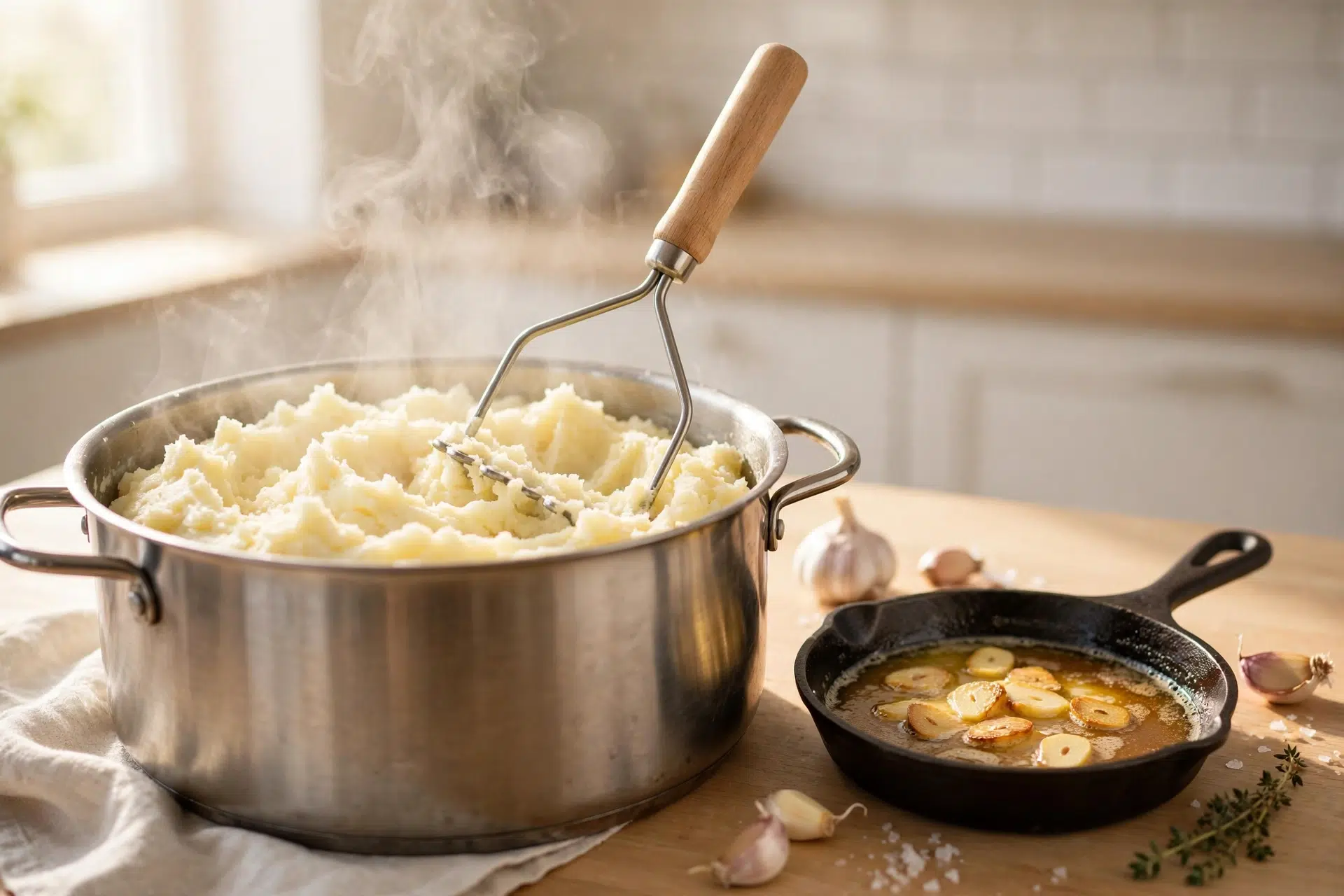
The Dry Minute That Keeps Them Fluffy, Never Gluey
Gluey mashed potatoes come from two causes: too much water left in the potatoes, and too much working once the starch is hot. The dry minute in step 6 attacks the first cause directly.
After draining, the cubes carry a film of cooking water that dilutes the butter and turns the mash loose and sticky. Sixty seconds back in the hot pot evaporates that film, and you can watch the surfaces change from shiny to matte.
The second cause is enthusiasm. A masher, used briefly, keeps the texture light. An electric mixer or food processor, used at all, ruptures the starch cells and sets the glue. If you own a ricer, it gives the smoothest result with the least work; press the potatoes through once and fold, never stir hard.
If the mash ever does go gluey on you, fold in a splash of hot milk and a knob of cold butter and stop touching it. It will not be perfect, but it will be respectable, and gravy forgives a great deal.
Smooth or Rustic: Picking Your Mash Texture
There are two correct textures for this bowl, and they suit different tables. The smooth version goes through a ricer, takes the full measure of warm milk, and eats like a sauce for the turkey, elegant and pourable at the edges.
The rustic version stays with the masher, uses about 3/4 of the milk, and leaves small soft lumps that catch the brown butter in pockets. It is the one I serve with roast chicken on a weeknight, when nobody is performing Thanksgiving.
Choose before you start mashing, because the texture is decided in the first 30 seconds of work. A mash can always be loosened with more warm milk; it can never be unworked.
Skin is another quiet choice. Yukon Gold skins are thin enough to leave on for the rustic bowl, well scrubbed, which saves 3 minutes of peeling and adds a pleasant fleck of gold through the mash.
Yukon, Russet or Red: Potato Swaps and a Dairy Free Bowl
Yukon Golds are the first choice because they sit between waxy and starchy: creamy when mashed, forgiving when held warm, and naturally golden. Russets work too and mash fluffier, but they drink more milk, so warm an extra 1/4 cup and add it gradually.
Red potatoes give a chunkier, more rustic bowl with a slightly sweeter taste. They resist smoothness, so serve them masher style and lean into it.
For a dairy free bowl, brown the butter swap carefully: a good olive oil warmed with the garlic until fragrant stands in for the brown butter, and warm unsweetened oat milk replaces the dairy. The result is different, more savory than nutty, but genuinely good.
Sour cream is the classic enrichment if you want tang: swap half the cream for 1/4 cup of sour cream, folded in at the end so it stays bright. Buttermilk does a similar job with a lighter hand.
Holding Them Warm Through a Long Thanksgiving
Mashed potatoes are at their best in the first 20 minutes, but Thanksgiving rarely runs on that schedule. The good news is that this bowl holds well for up to 2 hours with one simple setup.
Transfer the finished mash to a heatproof bowl, smooth the top, and dot it with a thin film of warm milk to stop a skin forming. Set the bowl over a saucepan with 2 inches of barely simmering water, cover with a clean towel and then a lid, and keep the water at the barest bubble.
Stir once every 30 minutes or so, adding a spoonful of warm milk if the edges look dry. Five minutes before serving, stir in a fresh knob of butter and the reserved chives, and the bowl tastes newly made.
For a longer lead, make the whole recipe up to 2 days ahead without the chives, refrigerate it in its serving dish, and reheat covered at 350 degrees F for about 25 minutes with 1/4 cup of warm milk stirred in at the end. Slow cookers also hold mashed potatoes kindly on the warm setting, with the same milk film on top.
However you hold them, keep the 15 minute turkey gravy plan in the same hour, because the two are served together and both reheat without complaint.
Next Day Potatoes: Patties, Soup and Pie Tops
Leftover garlic mashed potatoes are an ingredient, not a problem. Stir in an egg and a handful of flour, form patties, and fry them in butter until crisp at the edges; they are the best breakfast of the whole holiday weekend.
A looser spoonful thins into soup: whisk mash into hot chicken broth with a splash of cream, then top with chives and crumbled cheese for a baked potato soup that tastes planned.
The classic move is a shepherd’s pie top. Spoon the mash over leftover turkey and vegetables in a baking dish, rough up the surface with a fork so it browns in ridges, and bake until bubbling.
For company, pipe or spoon the mash into a buttered dish alongside maple pecan mashed sweet potatoes and let the two bowls share the table; the sweet and savory contrast is exactly what a holiday plate wants, and both sit happily next to cranberry pecan wild rice pilaf and a pan of 30 minute green bean casserole.
Leftovers keep 3 to 4 days in the fridge in a sealed container. Freezing works for up to a month; thaw in the fridge and reheat gently with warm milk, since the brown butter flavor survives the freezer better than the texture does.
The mashed potato reference page gives a short, interesting history of the dish and its regional versions.
Questions About These Garlic Mashed Potatoes
Can I make garlic mashed potatoes without browning the butter? Yes. Melt the butter, bloom the garlic in it for 30 seconds, and proceed. You lose the nutty depth that makes this version special, but the garlic flavor stays and the clock gets 3 minutes shorter.
Why did my mashed potatoes turn out gluey? Almost always overworking. Hot potato starch turns to paste under a mixer or a long session with a spoon. Mash briefly, stir only until the milk disappears, and make sure the potatoes had their dry minute so you are not fighting extra water.
Can I leave the garlic out for kids or picky eaters? Easily. Brown the butter on its own and add a pinch of garlic powder at the table for the adults, or stir a spoonful of the garlic butter into individual bowls. The plain brown butter version is rich enough to stand alone.
What is the best potato if I want the smoothest possible mash? Russets through a ricer give the fluffiest, smoothest result, with Yukon Golds a close second and a better flavor. Reds never fully smooth out, which is a feature if you like a rustic bowl and a problem if you do not.
How far ahead can I peel and cube the potatoes? Up to 24 hours, held in cold water in the fridge so they do not discolor. Drain and start them in fresh cold salted water; the clock in this recipe assumes room temperature water at the start either way.
Print
Brown Butter Garlic Mashed Potatoes
Garlic mashed potatoes in 30 honest minutes: small Yukon Gold cubes, butter browned with sliced garlic while the potatoes boil, warm milk and cream, and a one minute steam dry that keeps the mash fluffy, never gluey.
- Total Time: 30 minutes
- Yield: 8 servings 1x
Ingredients
- 3 pounds Yukon Gold potatoes, peeled and cut into 3/4 inch cubes
- 1 tablespoon fine sea salt, for the cooking water, plus more to taste
- 8 tablespoons unsalted butter, divided
- 4 cloves garlic, thinly sliced
- 3/4 cup whole milk
- 1/4 cup heavy cream
- 1/2 teaspoon fine sea salt, for seasoning the mash
- 1/4 teaspoon black pepper
- 2 tablespoons finely snipped fresh chives, plus more to serve
- Flaky sea salt, to finish (optional)
Instructions
- Put the potato cubes in a large pot, cover with cold water by 1 inch, and stir in the tablespoon of salt. Set over high heat and bring to a boil.
- Reduce to a lively simmer and cook for 12 minutes, until a cube crushes easily against the side of the pot with a fork.
- While the potatoes cook, melt 6 tablespoons of the butter in a small skillet over medium heat. Swirl as it foams and cook until the milk solids turn amber and smell nutty, about 4 minutes.
- Drop the sliced garlic into the brown butter, swirl for 30 seconds until fragrant and just golden, then pull the skillet off the heat.
- Warm the milk and cream together until steaming, not boiling. Keep warm.
- Drain the potatoes, return them to the hot empty pot over low heat for 1 minute, shaking twice, until the surfaces look dry and matte.
- Off the heat, pour in the brown butter and garlic with every browned bit, and mash until the butter disappears.
- Add half the warm milk mixture and mash again. Add the rest and stir just until fluffy with soft peaks.
- Fold in the remaining 2 tablespoons of butter in small pieces, the seasoning salt, pepper and chives. Taste and adjust the salt.
- Spoon into a warm bowl, swirl the top, finish with extra chives and flaky salt, and serve.
- Prep Time: 12 minutes
- Cook Time: 18 minutes
Nutrition
- Serving Size: 3
- Calories: 270
- Sugar: 3
- Sodium: 450
- Fat: 15
- Saturated Fat: 9
- Unsaturated Fat: 5
- Trans Fat: 0
- Carbohydrates: 33
- Fiber: 3
- Protein: 4
- Cholesterol: 40
2 commentaires sur « 30-Minute Brown Butter Garlic Mashed Potatoes »