
In this article:
- The no-chill dough: how these molasses cookies keep the 25 minute promise
- Dark, warm and barely sweet: the flavor balance
- The crackle top: coarse sugar and a confident roll
- Ingredients
- Mixing, rolling and baking the cookies, step by step
- Pull them early: the underbake rule behind the chew
- Turning the spice dial: bolder, milder, orange zested
- Built for the cookie box: gifting, freezing and shipping
- Keeping them soft on day three
- Questions about these soft molasses cookies
These soft molasses cookies are my answer to the December afternoon when the cookie box needs filling tonight, not tomorrow, and every recipe on the internet wants to park the dough in the fridge for hours.
They come out deep mahogany and crackled, rolled in coarse sugar that sparkles under kitchen light, with edges that hold and centers that stay soft and chewy for days.
The spice is warm rather than hot: ginger first, cinnamon close behind, a whisper of clove, and the dark caramel pull of real molasses underneath everything.
Start to finish, they take 25 minutes. There is no chilling step hiding in the fine print, no softened butter to plan around, and no second day required before the first cookie can be eaten.
The dough is built differently on purpose, and once you understand the three small changes that replace the chill, this becomes the Christmas cookie you can make on a whim.
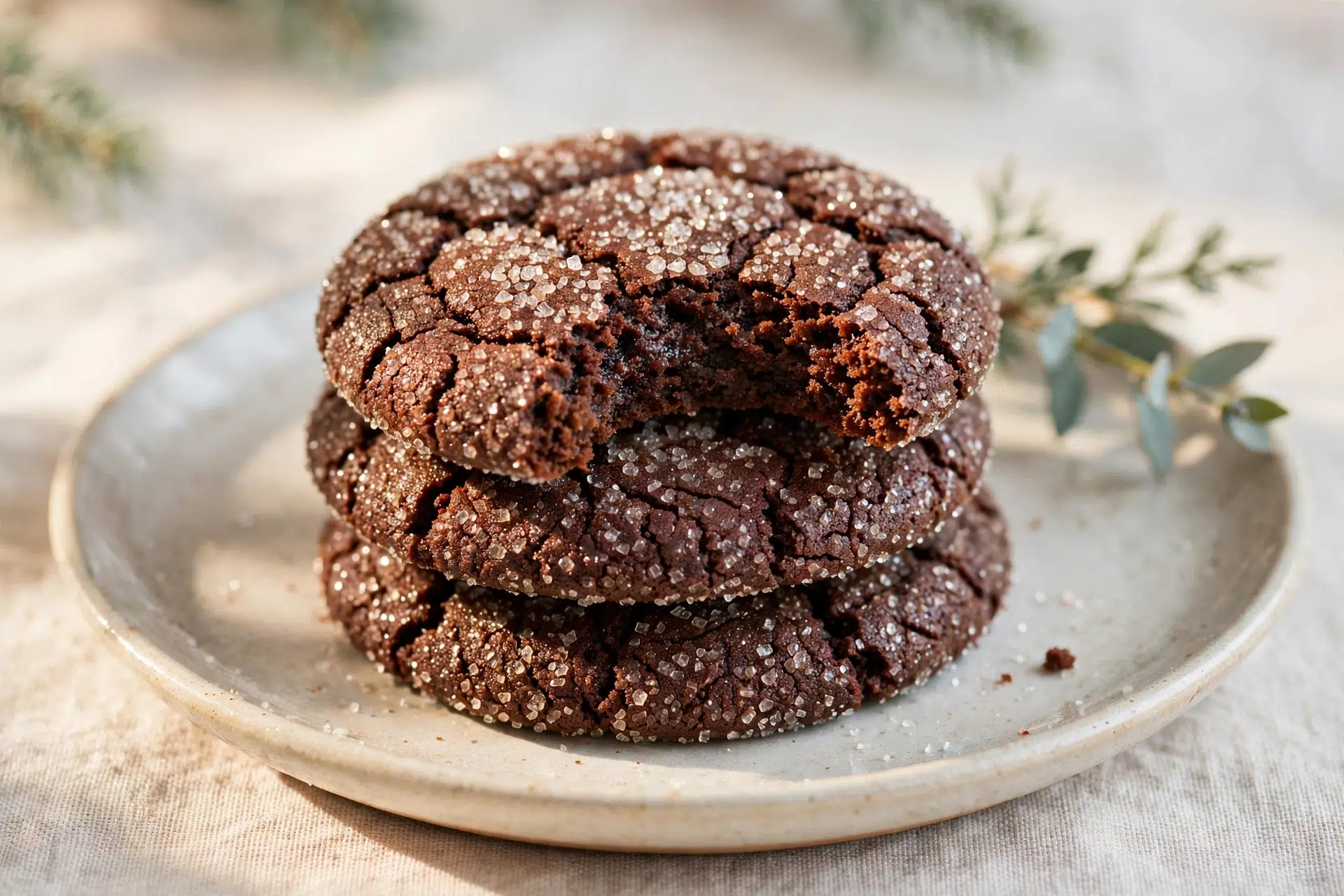
The No-Chill Dough: How These Molasses Cookies Keep the 25 Minute Promise
Most molasses cookies chill because their dough is too soft to hold a shape in a hot oven. Butter at room temperature plus a full cup of molasses gives you a batter that spreads into lace unless the fridge firms it up first.
This recipe removes the need instead of the symptom. The butter goes in melted, which sounds like it should spread more, but it lets the flour hydrate fully and evenly, and the dough firms as it stands on the counter for the two minutes you spend rolling.
An extra egg yolk replaces the whole second egg. Yolk brings richness and structure without the extra water of a white, and water is what makes a hot cookie puddle.
The flour measure is a touch higher than the classic ratio, and the molasses sits at 1/3 cup rather than 1/2. The flavor stays dark and deep, but the dough holds a round shape from the moment it lands on the tray.
Both trays bake at the same time, one on each rack, swapped halfway. That single decision is what turns a 40 minute batch into a 25 minute one without rushing a single step.
Dark, Warm and Barely Sweet: The Flavor Balance
A good molasses cookie should taste like the inside of a gingerbread house smells. The sweetness is real but restrained, so the spices and the molasses read as flavor rather than sugar.
Brown sugar does double duty here: its own molasses notes deepen the crumb, and its moisture is part of why these cookies stay chewy on day three. Granulated sugar stays in a supporting role, mostly in the rolling bowl.
The spice blend leans on ginger at 2 teaspoons, because ginger is what makes a molasses cookie taste like Christmas instead of like a plain spice cookie. Cinnamon rounds it out, clove adds the dark low note, and nutmeg fills the gap between them.
Salt matters more than bakers expect. At 3/4 teaspoon it sharpens every spice and keeps the dark sugars from tasting flat. Skip it and the cookies are sweet and dull; include it and people ask what your secret is.
These sit naturally next to 25 minute gingerbread crinkle cookies on a holiday tray: cousins in spice, different in texture, one crackled and pale, these dark and chewy.
The Crackle Top: Coarse Sugar and a Confident Roll
The crackled top is not an accident of baking; it is built. As the cookie rises and spreads in the oven, the surface dries and splits into a pale web over the dark crumb. Three things make it happen reliably.
First, the sugar coating. Coarse or sanding sugar, rolled generously over each ball, dries the surface faster than the interior and gives the crackle its sparkle. Granulated sugar works, but the crackle reads softer and the crunch disappears.
Second, a firm, round ball. Roll each portion between your palms until it is smooth and compact. A rough, loosely packed ball spreads unevenly and cracks in one big split instead of the fine web you want.
Third, room on the tray. Twelve cookies per half sheet, no more, so the heat circulates and the edges set before the centers slump. Crowded trays steam, and steamed cookies do not crackle.
The result is a cookie that looks like it came from a bakery case: dark, glossy in the cracks, glittering at the edges, and unmistakably homemade once you bite in.
Size helps the crackle too. Portions of 1 1/2 tablespoons spread into a three inch cookie, wide enough for the web pattern to show and thick enough to stay chewy. Mini versions bake faster and crackle less; bakery sized ones need an extra minute and lose their soft center. This middle size is the sweet spot the recipe is built around.
Ingredients
- 3/4 cup unsalted butter, melted and slightly cooled
- 1 cup packed dark brown sugar
- 1/4 cup granulated sugar, plus 1/3 cup coarse or sanding sugar for rolling
- 1 large egg plus 1 egg yolk, at room temperature
- 1/3 cup molasses, not blackstrap
- 1 teaspoon pure vanilla extract
- 2 3/4 cups all-purpose flour, spooned and leveled
- 2 teaspoons baking soda
- 2 teaspoons ground ginger
- 1 1/2 teaspoons ground cinnamon
- 1/2 teaspoon ground cloves
- 1/4 teaspoon ground nutmeg
- 3/4 teaspoon fine sea salt
Mixing, Rolling and Baking the Cookies, Step by Step
- Heat the oven to 350 degrees F. Line two large baking sheets with parchment paper, and put the coarse sugar in a small shallow bowl.
- Whisk the melted butter, brown sugar and granulated sugar in a large bowl until glossy and combined, about 30 seconds.
- Whisk in the egg, the yolk, the molasses and the vanilla until the mixture looks like dark caramel and falls in ribbons.
- Sprinkle the flour, baking soda, ginger, cinnamon, cloves, nutmeg and salt over the bowl. Fold with a spatula just until no dry flour shows; the dough will be soft, dark and slightly sticky.
- Scoop the dough into 24 portions of about 1 1/2 tablespoons each. Roll each one between your palms into a smooth ball.
- Roll each ball firmly in the coarse sugar until fully coated, then set 12 balls on each prepared sheet, spaced well apart.
- Bake both sheets at once, one on the upper rack and one on the lower, for 9 to 10 minutes, swapping racks and turning the sheets halfway.
- Pull the trays when the edges look set and matte and the centers are still puffed and soft. The cookies will look underdone in the middle, and that is exactly right.
- Leave the cookies on the hot trays for 5 minutes to finish setting, then move them to a rack. They firm as they cool and stay chewy in the center.
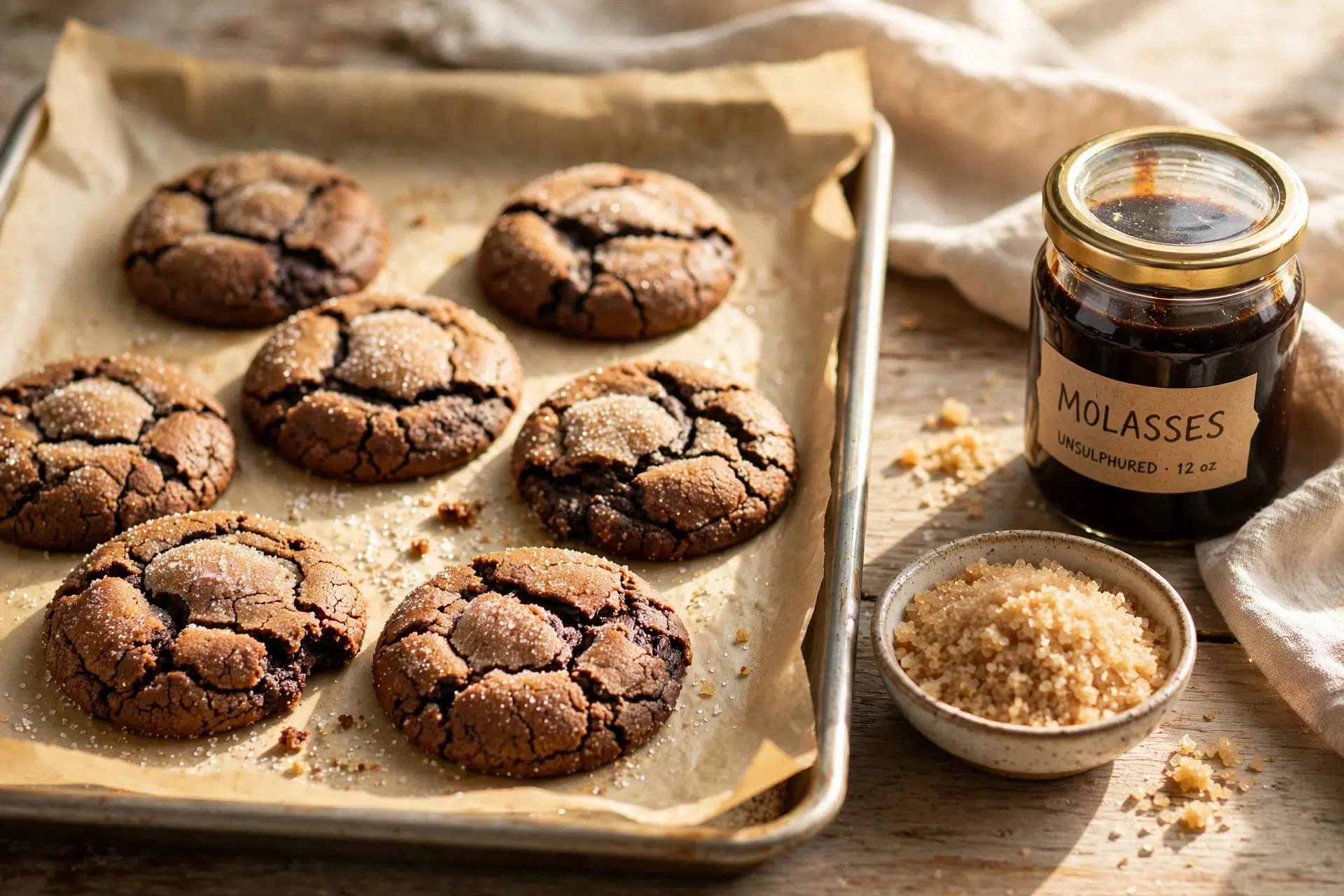
Pull Them Early: The Underbake Rule Behind the Chew
The difference between a soft molasses cookie and a hard one is about ninety seconds. Molasses and brown sugar keep absorbing moisture as the cookie cools, so a cookie that feels perfect in the oven dries out on the rack.
Pull the trays when the centers still look slightly wet and puffed, with the edges just set. The carryover heat of the pan finishes the job gently, and the crumb sets into that dense, bendy chew.
If your oven runs hot, start checking at 8 minutes. A pale ring at the edge of the bottom is fine; deep browning underneath means the sugar is scorching and the chew is already lost.
This same instinct serves the whole holiday tray. Cookies like cranberry orange shortbread want full baking because they are crisp by design; drop cookies with molasses want mercy.
Turning the Spice Dial: Bolder, Milder, Orange Zested
The recipe as written lands in the warm middle, spiced enough to notice and gentle enough for kids. From there, the dial turns easily in both directions.
For a bolder cookie, add 1/4 teaspoon of finely ground black pepper and an extra 1/2 teaspoon of ginger. The pepper blooms in the heat and reads as warmth rather than fire, the way it does in old fashioned spice cookies.
For a milder batch, cut the cloves to 1/4 teaspoon and the ginger to 1 1/2 teaspoons, and add an extra pinch of cinnamon. The molasses moves forward and the cookie tastes rounder and sweeter.
The orange turn is my favorite for gifting: fold in 1 teaspoon of finely grated orange zest with the vanilla. Citrus lifts the dark sugars exactly the way it does in the molasses based holiday breads of northern Europe, where zest and spice have traveled together for centuries.
A chocolate turn works too. Fold 1/2 cup of mini chocolate chips into the finished dough. They melt into dark pockets that suit the spice, though the crackle shows best on the plain version.
Built for the Cookie Box: Gifting, Freezing and Shipping
These cookies were designed with the December cookie box in mind, which means three practical questions: do they travel, do they keep, and do they freeze. The answer to all three is yes, with small print.
They travel well because the crumb is sturdy at the edges and the sugar crust protects the top. Pack them in a single layer or back to back in pairs, with parchment between layers, and keep them away from peppermint candies, whose flavor migrates.
They keep for 5 days in a sealed tin at room temperature, and the flavor actually deepens on day two as the spices settle into the crumb.
The dough freezes beautifully in ball form. Roll and sugar the balls, freeze them solid on a tray, then bag them for up to 3 months. Bake from frozen at 350 degrees F for 11 to 12 minutes, and a weeknight in January gets Christmas cookies with no notice at all.
In a mixed box, pair them with something pale and crisp for contrast: they sit beautifully beside no-bake gingerbread truffles and any shortbread you have going, and the dark color makes the whole box look composed.
Keeping Them Soft on Day Three
Molasses cookies have a built in advantage: molasses pulls moisture from the air, so these soften rather than stale when stored right. The trick is to give them the right conditions and then leave them alone.
Store the cooled cookies in a sealed container with a small piece of sandwich bread tucked inside. The cookies take moisture from the bread over a day or two, and the bread goes stale in their place.
Keep the container at room temperature, never in the fridge, where the cold dries the crumb and dulls the spices. If a batch does firm up, 8 seconds in the microwave under a damp paper towel brings the chew back for serving.
Baked cookies also freeze well for up to 2 months, layered with parchment in a rigid container. Thaw them in the closed container so condensation lands on the box, not on the sugar tops.
One last note for planners: the dough can wait, even though it does not have to. Mixed dough keeps 2 days in the fridge in a covered bowl; let it stand 15 minutes at room temperature before rolling, and the 25 minute promise becomes a 10 minute bake whenever you are ready.
Questions About These Soft Molasses Cookies
Can I use blackstrap molasses in these molasses cookies? You can, but the flavor turns bitter and the color nearly black. Blackstrap is the third boiling of the cane syrup, concentrated and mineral heavy. Regular unsulphured molasses, the kind labeled mild or original, gives the deep caramel flavor this recipe is balanced for.
Why did my cookies spread into thin pancakes? Three usual causes: the butter was hot rather than melted and cooled, the flour was scooped from the bag and under-measured, or the trays went in before the oven reached temperature. Let the butter cool 5 minutes, spoon and level the flour, and preheat fully.
Can I make the dough without the extra yolk? A whole second egg works in a pinch, but the cookies spread a little more and the crumb turns cakey rather than chewy. If that is your only option, add 1 extra tablespoon of flour to steady the dough.
Do these cookies need the coarse sugar, or is granulated fine? Granulated sugar coats them and tastes fine, but the signature crackle and sparkle come from the coarse grains drying the surface. If you bake often in December, one bag of sanding sugar earns its shelf space across the whole season.
How do I know the cookies are done if the centers look raw? Look at the edges, not the centers. Set, matte edges with puffed, soft centers is the exact moment to pull the tray. The centers finish on the hot pan during the 5 minute rest, and that rest is part of the recipe, not a suggestion.
Print
Soft Molasses Cookies
Soft molasses cookies in 25 minutes with no chilling: a melted butter, extra yolk dough rolled in coarse sugar for a crackled top, baked on two trays at once and pulled early so the centers stay chewy for days.
- Total Time: 25 minutes
- Yield: 24 cookies 1x
Ingredients
- 3/4 cup unsalted butter, melted and slightly cooled
- 1 cup packed dark brown sugar
- 1/4 cup granulated sugar, plus 1/3 cup coarse or sanding sugar for rolling
- 1 large egg plus 1 egg yolk, at room temperature
- 1/3 cup molasses, not blackstrap
- 1 teaspoon pure vanilla extract
- 2 3/4 cups all-purpose flour, spooned and leveled
- 2 teaspoons baking soda
- 2 teaspoons ground ginger
- 1 1/2 teaspoons ground cinnamon
- 1/2 teaspoon ground cloves
- 1/4 teaspoon ground nutmeg
- 3/4 teaspoon fine sea salt
Instructions
- Heat the oven to 350 degrees F. Line two large baking sheets with parchment paper and put the coarse sugar in a small shallow bowl.
- Whisk the melted butter, brown sugar and granulated sugar in a large bowl until glossy, about 30 seconds.
- Whisk in the egg, the yolk, the molasses and the vanilla until the mixture looks like dark caramel.
- Sprinkle the flour, baking soda, ginger, cinnamon, cloves, nutmeg and salt over the bowl. Fold just until no dry flour shows.
- Scoop 24 portions of about 1 1/2 tablespoons each and roll each one between your palms into a smooth ball.
- Roll each ball firmly in the coarse sugar until fully coated, then set 12 balls on each sheet, spaced well apart.
- Bake both sheets at once, one on the upper rack and one on the lower, for 9 to 10 minutes, swapping racks and turning the sheets halfway.
- Pull the trays when the edges look set and matte and the centers are still puffed and soft.
- Leave the cookies on the hot trays for 5 minutes, then move them to a rack to cool.
- Prep Time: 15 minutes
- Cook Time: 10 minutes
Nutrition
- Serving Size: 1
- Calories: 160
- Sugar: 17
- Sodium: 170
- Fat: 6
- Saturated Fat: 4
- Unsaturated Fat: 2
- Trans Fat: 0
- Carbohydrates: 24
- Fiber: 1
- Protein: 2
- Cholesterol: 30
1 commentaire sur « 25-Minute Soft Molasses Cookies »