
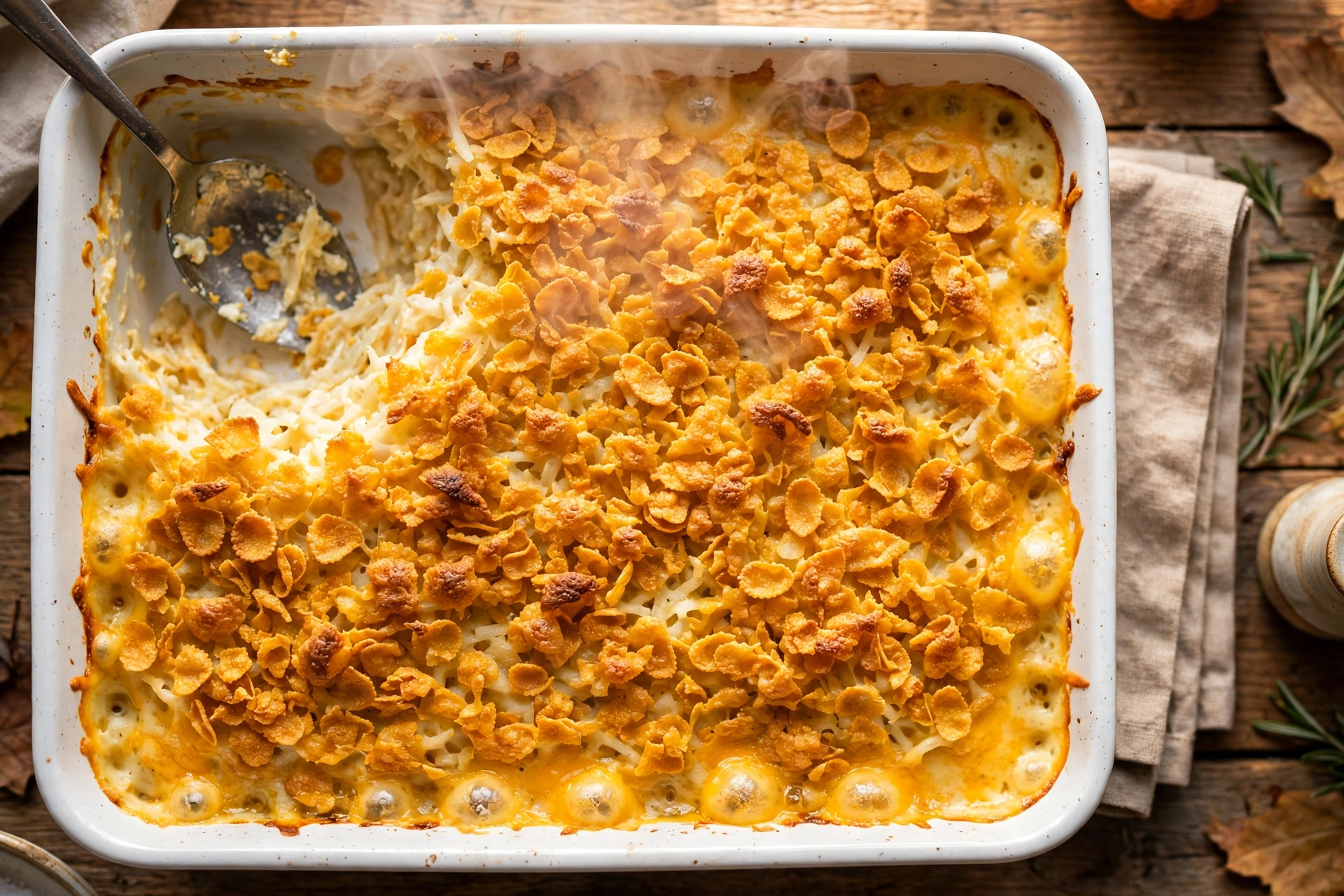
Ask a room of Utah grandmothers what belongs next to the holiday turkey and the answer comes back unanimous: funeral potatoes. The name is pure church basement history. This is the cheesy hash brown casserole that shows up at every funeral luncheon, every potluck and every Thanksgiving table in the Mountain West, creamy in the middle, capped with buttered cornflakes, and always, always the first dish scraped clean.
The only problem is the clock. The classic version bakes for the better part of an hour, and on Thanksgiving Day that hour of oven time is the most expensive real estate in your kitchen. The turkey wants the oven. The rolls want the oven. A potato casserole that monopolizes a rack for 60 minutes is a casserole that gets bumped to a lesser holiday.
These 30-minute funeral potatoes keep everything people love about the original and steal the time back with one move: the casserole starts on the stovetop. The potatoes simmer directly in their sauce for a few minutes, arriving at the oven already hot and nearly cooked, so the bake shrinks to a fast, fierce 12 minutes that exists for one reason only, to bubble the edges and turn the cornflake top deep gold. No canned soup, no thawing potatoes on the counter, no hour of waiting. If a cheesy potato side is your love language, our 30-Minute Stovetop Scalloped Potatoes use the same skillet-first trick with sliced potatoes.
On This Page
- The Stovetop Head Start That Cuts the Bake in Half
- Everything That Goes Into the Dish
- Skillet First, Then a Short Hot Bake
- A Cornflake Top That Stays Crisp at the Table
- Half Batch for Six, Double Batch for the Whole Table
- Assembling Ahead So Thanksgiving Morning Stays Calm
- Questions About These Funeral Potatoes
The Stovetop Head Start That Cuts the Bake in Half
A cold casserole in a moderate oven spends its first 20 minutes just warming through, and that warm-up is where the classic recipe burns its hour. We skip it entirely. The onion softens in butter, the frozen hash browns go straight into the pan, and the sour cream sauce simmers around them until everything is steaming. By the time the mixture lands in the baking dish it is already at serving temperature in the center, so a hot 450°F oven only has to do the finishing work: melt, bubble, crisp.
Here is the honest clock. Prep and onion: 6 minutes. Potatoes and sauce simmering on the stove: 8 minutes. Assembly and topping: 4 minutes. Bake: 12 minutes. That is 30 minutes, door to door, with a 5-minute rest while you carve. Using the potatoes from frozen is deliberate, not lazy. The stovetop simmer drives off the surface moisture that makes thawed potatoes weep into the sauce, which is the number one reason funeral potatoes come out watery. The pan does the draining for you.
Pan choice matters more than usual here. A wide Dutch oven or a 12-inch deep skillet gives the frozen shreds room to steam instead of stewing in their own meltwater, and heavy bottoms hold the gentle simmer the sour cream needs. If your largest pan is a standard skillet, work the potatoes in two batches for the first 4 minutes, then combine everything for the sauce; crowded shreds steam, spaced shreds dry, and dry shreds are what keep the finished casserole thick enough to scoop in clean squares. A thin pan on high heat is the one real way to scorch the sauce, so keep the burner at medium and let the steam do the work.
One more upgrade: there is no canned soup in this kitchen. The sauce is sour cream loosened with milk, seasoned like we mean it, with cheddar melted straight into it. It tastes like potatoes and cheese, not like a can, and it takes exactly one extra minute. For the safe handling of the leftovers this casserole always produces, the USDA leftovers guide is the reference we follow, and the storage chart at FoodSafety.gov backs up the timings in the make-ahead section below.
Everything That Goes Into the Dish
Fourteen everyday ingredients, nothing canned but the crunch on top. Shredded hash browns give the classic texture; cubed work too, with 2 extra minutes of simmering. Sharp cheddar is non-negotiable here, because mild cheddar disappears into the sour cream. Buy a block and shred it yourself if you can; pre-shredded cheese is coated against melting and the sauce will be slightly grainy.
- Frozen shredded hash brown potatoes, 2 pounds (about 8 cups), used straight from frozen
- Unsalted butter, 2 tablespoons, plus more for greasing the dish
- Yellow onion, 1 small, finely diced (about 3/4 cup)
- Garlic, 2 cloves, minced
- Sour cream, 1 1/2 cups, full fat for the silkiest sauce
- Whole milk, 1/2 cup
- Fine sea salt, 1 teaspoon
- Garlic powder, 1/2 teaspoon
- Onion powder, 1/2 teaspoon
- Black pepper, 1/4 teaspoon, freshly ground
- Sharp cheddar cheese, 2 1/2 cups shredded, divided
- Cornflakes, 2 cups, lightly crushed by hand
- Unsalted butter, 3 tablespoons, melted, for the topping
- Green onions or parsley, 2 tablespoons sliced or chopped, for serving
No hash browns in the freezer? Finely diced raw potatoes simmered 4 minutes longer get you close, though the shreds are what make it funeral potatoes and not just a gratin. Greek yogurt swaps for half the sour cream if you like a tangier sauce; swap all of it and the sauce may split at 450°F, so keep at least half sour cream for insurance.
Skillet First, Then a Short Hot Bake
You need a large, deep skillet or a Dutch oven for the stovetop phase, wide enough to toss 2 pounds of potatoes without a fight. Work in the order written; the sauce builds while the potatoes are still cold, which keeps the sour cream from breaking.
- Heat the oven and prep the dish. Position a rack in the upper third and heat the oven to 450°F (230°C). Butter a 9×13-inch baking dish and set it near the stove.
- Soften the onion. Melt the 2 tablespoons butter in the skillet over medium heat. Add the onion and cook, stirring now and then, until soft and sweet, about 3 minutes. Stir in the garlic for 30 seconds.
- Add the frozen potatoes. Tip in the hash browns straight from the bag, no thawing. Toss them through the butter and cook, stirring every minute or so, until the shreds separate and steam strongly, about 4 minutes. This is the moisture leaving; let it.
- Build the sauce in the pan. Lower the heat, add the sour cream, milk, salt, garlic powder, onion powder and pepper, and fold until every shred is coated. Simmer gently, stirring, until the sauce is glossy and steaming throughout, 3 to 4 minutes.
- Melt in the cheese. Take the pan off the heat and fold in 2 cups of the cheddar until it melts into the sauce. Taste and add a pinch more salt if your cheese was mild.
- Fill the dish. Scrape the mixture into the buttered dish and smooth the top. Scatter the remaining 1/2 cup cheddar over the surface.
- Butter the cornflakes. In a small bowl, toss the lightly crushed cornflakes with the 3 tablespoons melted butter until every flake shines. Scatter them evenly over the casserole, edge to edge.
- Bake hot and fast. Bake until the edges bubble vigorously and the topping is deep golden, 10 to 12 minutes. If the top browns early, tent loosely with foil for the last minutes.
- Rest and serve. Rest 5 minutes so the sauce sets into scoops instead of soup. Shower with green onions or parsley and bring the whole dish to the table.
A Cornflake Top That Stays Crisp at the Table
The cornflake crust is half the identity of this dish, and sogginess is its only enemy. Three rules keep it shattering. Crush lightly: you want flakes the size of dimes, not crumbs, because powder soaks up butter and sauce and turns to paste. Butter generously: dry flakes steam instead of toasting. And keep the topping off the casserole until the moment it goes into the oven, which the fast method makes easy, since the topping is the last thing on.
Serving straight from the baking dish is part of the charm, and the dish travels well: wrap it in a thick towel, set it flat in a box or on a car floor, and it will hold its heat for the drive to any potluck in town. If the top softens in transit, 3 uncovered minutes in the host’s hot oven restores order, a trick worth whispering to whoever hosts next year. At the table, cut the first scoop from a corner; the corner pieces carry the highest ratio of crisp topping to creamy center, and in most families they are spoken for before the dish lands.
Leftovers reheat with their crunch intact if you use the oven, not the microwave: 10 minutes at 375°F uncovered brings the top back to life. A handful of fresh buttered flakes scattered over a reheated portion is the restaurant trick, and nobody at your table will complain about reinforcements. Potato chip crumbs, crushed crackers and panko all stand in for cornflakes in a pinch; panko wants an extra tablespoon of butter and a pinch of salt to keep up.
Half Batch for Six, Double Batch for the Whole Table
The full 9×13 serves 10 to 12 as a side, which is right for most Thanksgiving tables. For a small table of six, halve everything and bake in an 8×8-inch dish; the stovetop time drops by about a minute and the bake stays at 12 minutes, because the layer is the same depth. Watch the top, since a smaller dish browns a touch faster.
Doubling is where cooks get into trouble, because a deeper casserole breaks the 30-minute promise. Instead of one giant dish, split the double batch between two 9×13 dishes and bake them side by side; both finish in the same 12 to 14 minutes and the tops stay crisp. Build the sauce in your biggest pot, divide, top and bake. Sixteen to twenty people, fed, with the oven free again before the rolls even proof. If potatoes are the main event at your house, pair this dish with our 30-Minute Brown Butter Garlic Mashed Potatoes and let the table choose its fighter.
Assembling Ahead So Thanksgiving Morning Stays Calm
The smartest version of this recipe is the one you assemble the night before. Run the stovetop phase completely, scrape the sauced potatoes into the dish, cool, cover and refrigerate for up to 24 hours. Keep the buttered cornflakes in a separate container at room temperature; topping a cold casserole early is how good crunch goes to die.
On the day, let the dish sit out while the oven heats, add the topping, and bake at 450°F for 16 to 18 minutes, until the center is bubbling, since it starts cold. Fully baked leftovers keep 3 to 4 days in the fridge and freeze, tightly wrapped, for up to 2 months; thaw overnight and reheat covered at 350°F for 20 minutes, then uncover for 5 to recrisp. Assembling ahead also makes this the easiest dish to hand to a helper: the instructions fit on an index card. Round out the make-ahead menu with our 25-Minute Skillet Broccoli Cheese Casserole and the 15-Minute Garlic Green Beans With Crispy Shallots, and the whole side dish spread is under control.
Questions About These Funeral Potatoes
Can I make funeral potatoes without canned soup?
Yes, and this recipe already does. The sour cream, milk and melted cheddar build the same creamy body the soup usually provides, with a cleaner cheese flavor. If a can is what you have and love, stir it in with the sour cream and cut the milk to 1/4 cup; the timing does not change.
Why are my funeral potatoes watery?
Almost always the potatoes. Thawed hash browns release their water into the sauce as they bake. Starting from frozen on the stovetop, as written here, cooks that moisture off before the dish ever sees the oven. A sauce that looks slightly thick in the pan is perfect; it loosens as the cheese melts.
Do the hash browns really go in frozen?
They do. Give them the full 4 minutes of tossing in the hot pan so the shreds separate and steam. Clumps of still-frozen potatoes are the only failure mode, and a minute of extra stirring fixes them before the sauce goes in.
What can I use instead of cornflakes on top?
Crushed buttery crackers, panko tossed with butter and a pinch of salt, or even crushed potato chips all crisp beautifully in the 12-minute bake. Keep the butter; it is what turns a topping from dry to shattering.
Can I freeze funeral potatoes before baking?
Yes. Assemble the sauced potatoes in a freezer-safe dish without the topping, wrap tightly, and freeze for up to 2 months. Thaw overnight in the fridge, add the buttered cornflakes fresh, and bake at 450°F for 16 to 18 minutes, until the center bubbles. Freezing the topping separately is what keeps it tasting like it was made that morning.
Can funeral potatoes be the main dish?
At potlucks they already are. To make it official, fold in 2 cups of diced cooked chicken or turkey before baking and call it dinner; the casserole serves 6 as a main. It is also, for the record, an elite breakfast next to eggs the morning after Thanksgiving.
Print
30-Minute Funeral Potatoes
The classic cheesy hash brown casserole, rebuilt for a busy holiday: the potatoes simmer in their sour cream and cheddar sauce on the stovetop, then bake hot and fast under a buttered cornflake top. No canned soup, no thawing, 30 minutes door to door.
- Total Time: 30 minutes
- Yield: 12 servings 1x
Ingredients
- 2 pounds frozen shredded hash brown potatoes (about 8 cups), used straight from frozen
- 2 tablespoons unsalted butter, plus more for greasing the dish
- 1 small yellow onion, finely diced (about 3/4 cup)
- 2 cloves garlic, minced
- 1 1/2 cups sour cream, full fat
- 1/2 cup whole milk
- 1 teaspoon fine sea salt
- 1/2 teaspoon garlic powder
- 1/2 teaspoon onion powder
- 1/4 teaspoon black pepper
- 2 1/2 cups shredded sharp cheddar cheese, divided
- 2 cups cornflakes, lightly crushed by hand
- 3 tablespoons unsalted butter, melted, for the topping
- 2 tablespoons sliced green onions or chopped parsley, for serving
Instructions
- Heat the oven to 450°F (230°C) with a rack in the upper third. Butter a 9×13-inch baking dish.
- Melt the 2 tablespoons butter in a large deep skillet over medium heat. Cook the onion until soft, about 3 minutes, then stir in the garlic for 30 seconds.
- Add the frozen hash browns straight from the bag. Toss and cook, stirring every minute, until the shreds separate and steam strongly, about 4 minutes.
- Lower the heat. Add the sour cream, milk, salt, garlic powder, onion powder and pepper, and fold until coated. Simmer gently until glossy and steaming, 3 to 4 minutes.
- Off the heat, fold in 2 cups of the cheddar until melted into the sauce.
- Scrape into the prepared dish, smooth the top and scatter the remaining 1/2 cup cheddar over the surface.
- Toss the crushed cornflakes with the 3 tablespoons melted butter and scatter evenly over the casserole.
- Bake until the edges bubble vigorously and the topping is deep golden, 10 to 12 minutes.
- Rest 5 minutes, scatter with green onions or parsley, and serve.
- Prep Time: 10 minutes
- Cook Time: 20 minutes
Nutrition
- Calories: 315
- Sugar: 3
- Sodium: 430
- Fat: 20
- Saturated Fat: 11
- Carbohydrates: 26
- Fiber: 2
- Protein: 8
- Cholesterol: 48
1 commentaire sur « 30-Minute Funeral Potatoes »