
Every December, somebody’s grandmother sets a plate of Christmas haystacks on the cookie table, and every December, that plate empties first. Golden little mounds of crunchy noodles wrapped in butterscotch and peanut butter, salty and sweet in the same bite, they are the no-bake cookie that has been quietly winning Christmas since the 1950s. No oven, no mixer, no cookie scoop technique to master, just a bowl, a microwave and twenty minutes.
Twenty minutes is the part most recipes get wrong. They promise a quick no-bake treat and then quietly ask for an hour of setting time on the counter, as if the clock stopped caring once the spooning was done.
This version of Christmas haystacks counts honestly: melt, fold, scoop, decorate, and a fast 10 minutes in the refrigerator while the tray is cold, which is exactly how long it takes to wash the bowl and put the kettle on. When the timer dings, the haystacks are firm, glossy and ready for the cookie tin.
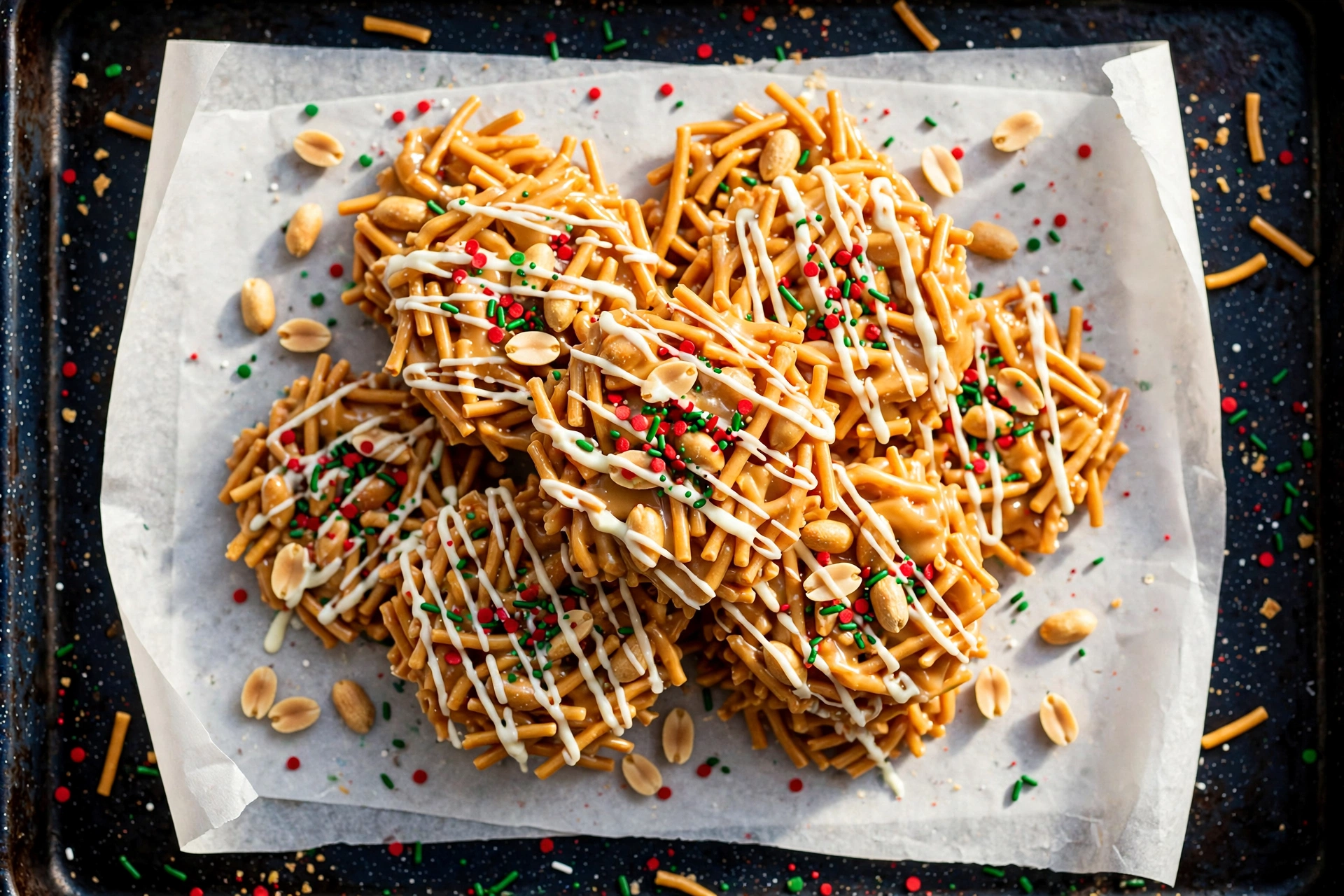
The Christmas dressing does the rest. A zigzag of white chocolate, a snowfall of red and green sprinkles while the tops are still shiny, and suddenly the humblest cookie on the table looks like it came from a bakery window. Make a double batch of Christmas haystacks and half of them walk out the door in gift tins; our 20-Minute Reindeer Chow is the other half of that gift strategy, since both keep for two weeks without complaint.
On This Page
- A 20-Minute Clock That Counts the Setting Time Too
- The Short Ingredient List, and Why Each One Matters
- Melting, Folding and Scooping, in That Order
- Dressed for Christmas: Drizzle, Sprinkles and Neat Little Stacks
- Chocolate, Peppermint and a Nut-Free Batch
- Cookie Tins, Freezer Bags and Two Weeks of Keeping
- Questions About These Christmas Haystacks
A 20-Minute Clock That Counts the Setting Time Too
Here is the whole recipe on one line: 4 minutes to melt, 6 minutes to fold and scoop, 10 minutes to set in the fridge. Three details make the fast set possible.
First, the baking sheet goes into the refrigerator empty while you melt, so the scoops land on a cold surface and start firming from the bottom up. Second, the scoops are small and even, a level 1 1/2-tablespoon cookie scoop, because fat little mounds insulate their own centers and set slowly. Third, the mixture is folded the moment the melt is smooth; butterscotch coating that waits around in a warm bowl starts to dull and stiffen, and stiff mixture makes ragged stacks that need handling, and handling costs minutes.
One honest note about microwaves: they range from sluggish to ferocious, and butterscotch notices the difference. A compact 700-watt model may need one extra 30-second round; a big 1200-watt model may finish in three rounds and punish a fourth.
The melt is done when stirring turns the last visible chips into ribbons that vanish; pull it early rather than late, because the bowl’s residual heat keeps working while you fold in the vanilla. If your microwave has no power-level setting, use 20-second bursts and stir twice as often; the recipe forgives patience and never forgives a scorched batch.
Room temperature setting works too, in 25 to 30 minutes in a cool kitchen, if the fridge is full of turkey.
But the refrigerator set is the one that keeps the 20-minute promise, and it also keeps the white chocolate drizzle snappy instead of soft. Plan the batch so the tray goes in as the last baking sheet comes out of the cookie production line, and the haystacks will be boxed before the oven cookies are cool.
The Short Ingredient List, and Why Each One Matters
Nine ingredients, all supermarket regulars, and not a brand name in sight. Butterscotch chips are the flavor and the glue; peanut butter loosens the melt and keeps the set tender instead of rock hard. The noodles must be the crisp, ready-to-eat kind sold for salads and snacking, not dried ramen and not fresh noodles, and they should taste fresh, because stale noodles stay stale under the coating. One small bag makes exactly one batch, which is the kind of math December deserves.
- Butterscotch baking chips, 1 bag (11 ounces, about 2 cups)
- Creamy peanut butter, 1/2 cup
- Vanilla extract, 1/2 teaspoon
- Fine sea salt, 1/4 teaspoon, plus a pinch more if your peanuts are unsalted
- Neutral oil, 1 teaspoon, only if the melt turns grainy
- Crispy chow mein noodles, 4 cups (about 5 ounces), the crunchy ready-to-eat kind
- Salted roasted peanuts, 1 cup
- White baking chips, 1/2 cup, melted, for the drizzle
- Red and green sprinkles, 2 tablespoons
The salt deserves its sentence: butterscotch is sweet enough to flatten every other flavor, and that quarter teaspoon is what makes the peanuts taste like peanuts and the whole cookie taste like more than sugar. Taste the melt before the noodles go in; it should read as salted caramel’s cheerful cousin. If your butterscotch chips are the kind that melts reluctantly, the teaspoon of oil in the list is the rescue, whisked in at the end until the surface goes glossy again.
Melting, Folding and Scooping, in That Order
Work quickly once the chips melt and keep the bowl dry; a single splash of water can seize the whole batch. A double boiler works if your microwave runs hot, with the same low and slow rule.
- Chill the pans and line them. Line two large baking sheets with parchment paper and slide one into the refrigerator to chill. Clear a fridge shelf for the second.
- Melt low and slow. Put the butterscotch chips and peanut butter in a large microwave-safe bowl. Microwave at 50% power in 30-second intervals, stirring well after each, until smooth and glossy, about 2 minutes total. Chips hold their shape as they melt, so stir even when they look solid.
- Season the melt. Stir in the vanilla and salt. If the mixture looks grainy or stiff, whisk in the teaspoon of oil until it shines again.
- Fold in the noodles. Add the chow mein noodles and fold gently with a spatula, turning from the bottom, until every strand is coated. Fold, do not stir hard; broken noodles make crumbs, and crumbs make flat cookies.
- Add the peanuts. Fold in the peanuts last so they stay whole and land throughout the mixture instead of sinking.
- Scoop neat little stacks. Working quickly, drop level 1 1/2-tablespoon scoops onto the chilled sheet first, then the second sheet, nudging each into a tidy mound with the back of the spoon. You should get about 24 haystacks.
- Drizzle and sprinkle. Melt the white baking chips in short intervals, drizzle back and forth over the stacks with a spoon or a small zip bag with the corner snipped, and shower with the sprinkles while the drizzle is still wet.
- Set fast. Refrigerate the sheets for 10 minutes, until the coating is firm and the haystacks lift cleanly off the parchment.
- Serve or pack. Serve straight away, or layer into tins between sheets of parchment the moment they are set.
Dressed for Christmas: Drizzle, Sprinkles and Neat Little Stacks
The difference between plain haystacks and Christmas haystacks is ninety seconds of decoration and a cookie scoop. The scoop is the unsung half: even mounds set at the same speed, stack in tins without a fight, and look deliberate on a cookie tray, and deliberate is what separates the homemade plate people photograph from the one people just eat. Keep the scoops level, not heaped, and press the stray noodles back into the mound with damp fingers before the coating firms.
For the drizzle, thin is the whole game. White baking chips melt thicker than chocolate; a few drops of neutral oil whisked in gives you ribbons instead of blobs. Zigzag from a height of about 6 inches so the lines land fine and even, and sprinkle immediately, one sheet at a time, because the drizzle skins over in about a minute.
Gold sanding sugar reads elegant, red and green reads classic, and crushed candy cane reads peppermint, which brings us to the variations. A plate of these next to our 20-Minute Peppermint Bark covers the whole sweet and salty argument in two recipes.
Chocolate, Peppermint and a Nut-Free Batch
The formula forgives swapping, as long as the proportions hold: about 2 cups of chips and 1/2 cup of peanut butter to 4 cups of noodles and 1 cup of crunch. For chocolate haystacks, use semisweet chips for the butterscotch and keep everything else; drizzle with the white chips as written and the contrast is striking.
For peppermint, use white baking chips as the base coating, add 1/4 teaspoon peppermint extract with the vanilla, skip the sprinkles and finish with 1/4 cup finely crushed candy canes, added at the table end so they stay crisp. The peppermint batch next to our 20-Minute Microwave Peanut Brittle makes a gift tin that looks planned in October.
The nut-free batch matters in December, because classroom and office tins travel to mixed crowds. Swap the peanut butter for sunflower seed butter, which behaves almost identically in the melt, and replace the peanuts with 1 cup of salted sunflower seeds or chopped pretzel sticks. The pretzel version is a little less rich and a little more salty, and in our kitchen it disappears at the same speed.
Label the tin; nut-free treats are only a kindness if the eater knows. For crunch insurance in any version, the King Arthur Baking recipe resources are a good reference for how coating ratios behave when you start doubling.
Cookie Tins, Freezer Bags and Two Weeks of Keeping
Christmas haystacks are born travelers. Set them fully, layer them in a tin between parchment sheets, and they keep at room temperature for a week, in the refrigerator for two, with the crunch intact, as long as the tin seals well and lives away from the stove’s steam. Warm kitchens soften the coating; if your house runs hot, the fridge is home base and the cookies come out 10 minutes before serving.
Christmas haystacks also freeze like champions. Freeze the set haystacks on their sheet for 30 minutes, then bag them with the air pressed out; they keep for 2 months and thaw on the counter in 15 minutes, still crunchy, which makes them the rare Christmas cookie you can finish in November and forget.
Ship them in a snug tin with parchment padding, in cool weather only, and choose the sturdy scoop size; broken noodles are still delicious but they photograph like an accident, and a December care package deserves better than arriving as sweet rubble at its destination. A tray built around these, our 25-Minute Christmas Crack and a handful of store-bought clementines is the whole cookie exchange, handled in one afternoon.
For a party platter rather than a tin, set the haystacks on a parchment-lined tray in a single layer and carry them exactly like that, because stacked cookies sweat against each other in a warm room and the drizzle prints onto whatever touches it.
Surround them with anything red (cranberries, clementines, a ribbon around the tray) and the golden stacks read as the centerpiece rather than the filler. Children can be trusted with the sprinkling step and with quality control, which in field testing removes about four cookies per batch; make the double batch if your kitchen employs small inspectors.
Questions About These Christmas Haystacks
Why did my butterscotch melt turn grainy?
Heat, almost every time. Butterscotch chips scorch and seize faster than chocolate, which is why the recipe insists on 50% power and 30-second intervals with real stirring. A grainy melt usually recovers with the teaspoon of oil whisked in off the heat; a scorched one tastes bitter and should be restarted, sadly, but the noodles will never know.
Can I use different noodles?
The crisp chow mein noodles sold in cans or bags for snacking are the right ones. Thin pretzel sticks are the best substitute and keep the crunch for days. Dried ramen, fresh noodles and cooked pasta all fail here, the first on texture, the rest on moisture, and moist noodles under a candy coating go soft within hours.
Why are my haystacks soft the next day?
Either the coating never fully set (give them the full fridge time) or the tin lives somewhere steamy. Move the tin to a cool cupboard or the fridge and they firm back up. Keeping the layers separated with parchment also stops the drizzle from gluing the stack together.
How many haystacks does one batch make?
About 24 with a level 1 1/2-tablespoon scoop, which is the right size for cookie trays and tins. Heaped scoops make 18 larger cookies that need 12 to 14 minutes of fridge time to set through. Doubling works cleanly in the same big bowl; melt in two rounds if your microwave is small.
Can I make haystacks without peanuts at all?
Yes; the nut-free variation above, with sunflower seed butter, sunflower seeds or pretzel sticks, sets the same way and keeps just as long. Chop nothing too fine, because the chunky contrast is the pleasure of the cookie, and label any tin that leaves your kitchen so nobody has to guess.
Print
20-Minute Christmas Haystacks
No-bake Christmas haystacks on an honest 20-minute clock, setting time included: butterscotch and peanut butter melt over crunchy chow mein noodles and salted peanuts, finished with a white chocolate drizzle and holiday sprinkles.
- Total Time: 20 minutes
- Yield: 24 haystacks 1x
Ingredients
- 1 bag (11 ounces, about 2 cups) butterscotch baking chips
- 1/2 cup creamy peanut butter
- 1/2 teaspoon vanilla extract
- 1/4 teaspoon fine sea salt
- 1 teaspoon neutral oil, only if the melt turns grainy
- 4 cups crispy chow mein noodles (about 5 ounces), the crunchy ready-to-eat kind
- 1 cup salted roasted peanuts
- 1/2 cup white baking chips, melted, for the drizzle
- 2 tablespoons red and green sprinkles
Instructions
- Line two large baking sheets with parchment paper and slide one into the refrigerator to chill.
- Put the butterscotch chips and peanut butter in a large microwave-safe bowl. Microwave at 50% power in 30-second intervals, stirring well after each, until smooth and glossy, about 2 minutes.
- Stir in the vanilla and salt. If the mixture looks grainy, whisk in the teaspoon of oil until it shines again.
- Add the chow mein noodles and fold gently with a spatula until every strand is coated.
- Fold in the peanuts until they are spread throughout the mixture.
- Working quickly, drop level 1 1/2-tablespoon scoops onto the prepared sheets, nudging each into a tidy mound, about 24 haystacks.
- Drizzle the melted white baking chips over the stacks and shower with the sprinkles while the drizzle is still wet.
- Refrigerate for 10 minutes, until the coating is firm and the haystacks lift cleanly off the parchment.
- Serve, or layer into tins between sheets of parchment.
- Prep Time: 10 minutes
- Cook Time: 4 minutes
Nutrition
- Calories: 165
- Sugar: 11
- Sodium: 105
- Fat: 9
- Saturated Fat: 4
- Carbohydrates: 18
- Fiber: 1
- Protein: 3
- Cholesterol: 0