
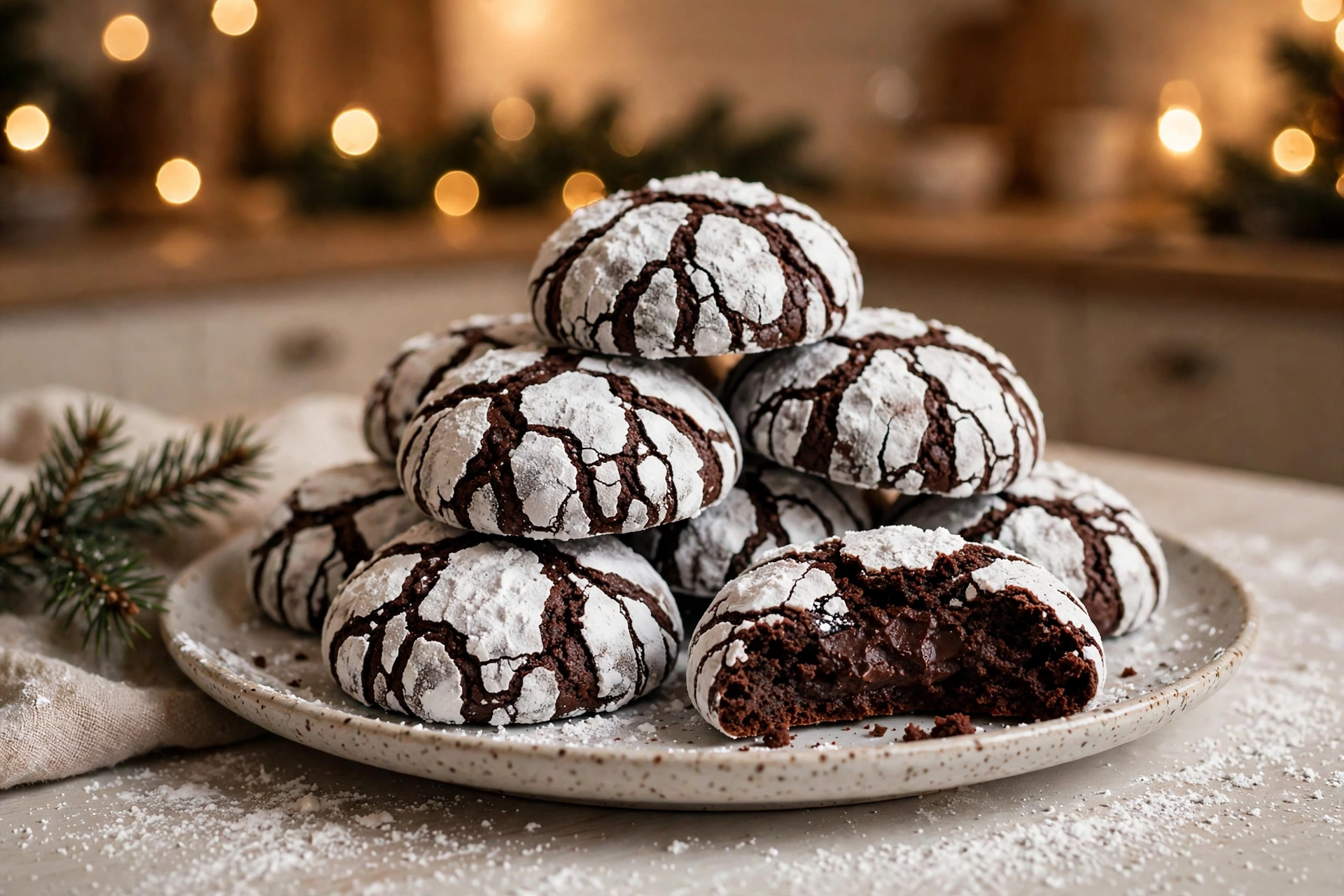
Chocolate crinkle cookies are the drama queens of the Christmas cookie box: dark as midnight under a snowfall of powdered sugar, split open in bold white cracks, soft as a brownie in the middle. They look like a bakery project. In most recipes, they also take like one, because nearly every version sends the dough to the refrigerator for two hours before you can roll a single ball.
These 25-minute chocolate crinkle cookies skip the refrigerator entirely. Not with a shortcut mix, and not with a dough so sticky it glues itself to your palms, but with a dough engineered stiff from the first whisk: melted butter, a serious dose of cocoa, and just enough flour to hold a scoop. Five quiet minutes on the counter while the oven heats, and it rolls like play dough.
The other secret is the double roll. Each ball goes through granulated sugar first, then powdered sugar, and that order is the whole difference between bold snowy cracks and the pale, melted looking tops that disappoint every December. Twenty-five minutes from bowl to cooling rack, and the cookie box is officially open.
On This Page
- The Double Sugar Roll That Makes the Cracks
- The Short Lineup of Ingredients
- Mix, Roll, Bake: 25 Minutes in Order
- A Dough Built Stiff Enough to Skip the Fridge
- Out of the Oven at the Right Minute
- Flavor Turns for the Next Batch
- Filling the Christmas Cookie Box
- Questions About These Chocolate Crinkle Cookies
The Double Sugar Roll That Makes the Cracks
A crinkle cookie cracks because the outside sets while the inside is still expanding. As the baking powder lifts the dough in the heat, the dry, sugar armored surface cannot stretch, so it splits, and the dark dough shows through the white in those dramatic fissures. Everything about the coating exists to protect that split second of oven physics.
Powdered sugar alone melts into a moist dough and turns gummy and translucent, which is why so many home batches come out with faint grey smudges instead of snow. The granulated sugar layer goes on first as a barrier: its coarse crystals keep the powdered sugar dry and separate from the dough, so the second coat stays white, thick and prone to cracking exactly where you want it.
Be generous. A shy dusting gives shy cracks. Each ball should look like a snowball that rolled downhill, coated so thickly you cannot see dough anywhere. Work in small batches of five or six balls so the coating stays dry, and if the last balls start looking damp, roll them a second time before they go on the pan.
The Short Lineup of Ingredients
Nine pantry ingredients plus two sugars for rolling. No box mix, no melted chocolate to fuss with; the deep chocolate flavor comes from cocoa alone, which also keeps the dough stiff enough to skip the chill.
- Unsalted butter, 1/4 cup (half a stick), melted and cooled for 2 minutes
- Granulated sugar, 1 cup, plus 1/4 cup more for rolling
- Unsweetened cocoa powder, 1/2 cup, Dutch process for the darkest color
- Large eggs, 2, at room temperature
- Vanilla extract, 1 teaspoon
- All-purpose flour, 1 1/4 cups, spooned and leveled
- Baking powder, 1 teaspoon
- Fine sea salt, 1/4 teaspoon
- Mini chocolate chips, 1/2 cup, optional but recommended
- Powdered sugar, 3/4 cup, for rolling
Dutch process cocoa is the right call here for two reasons: its dark, almost black color maximizes the contrast against the white coating, and its smoother, less acidic flavor reads as pure chocolate. Natural cocoa works and tastes a touch sharper, but the cookies bake up a lighter brown, and the cracks lose some of their drama. Room temperature eggs whisk in smoothly; cold eggs can seize the melted butter into flecks.
Mix, Roll, Bake: 25 Minutes in Order
You need two bowls for rolling sugar, one mixing bowl, and a tablespoon scoop if you have one. The dough rests 5 minutes, not in the fridge, just on the counter, and that pause is built into the clock.
- Heat the oven and line the pans. Heat the oven to 350°F (175°C). Line two baking sheets with parchment. Put the 1/4 cup granulated sugar in one shallow bowl and the powdered sugar in another.
- Whisk butter, sugar and cocoa. In a large bowl, whisk the melted butter, the 1 cup granulated sugar and the cocoa powder into a thick, glossy paste, about 1 minute. It will look like wet sand turning to fudge; that stiffness is by design.
- Add eggs and vanilla. Whisk in the eggs one at a time, then the vanilla, until the mixture loosens into a thick, shiny batter.
- Fold in the dry ingredients. Sprinkle the flour, baking powder and salt over the bowl and fold with a spatula just until no dry streaks remain. Fold in the mini chips if using. The dough should be stiff enough to hold a scoop mark.
- Rest 5 minutes on the counter. Leave the bowl alone while the oven finishes heating. The flour hydrates, the cocoa blooms and the dough firms from batter to rollable. This is the entire rest; there is no refrigerator step hiding anywhere.
- Scoop and roll twice. Scoop tablespoon sized portions and roll into balls between your palms. Roll each ball first in granulated sugar to coat completely, then in powdered sugar, generously, until it looks like a snowball.
- Arrange and bake. Set the balls 2 inches apart on the prepared sheets. Bake one sheet at a time for 10 to 11 minutes, until the tops are crackled and the edges look set but the centers still appear soft and slightly shiny.
- Cool on the pan. Leave the cookies on the hot sheet for 5 minutes; they finish setting as they cool and the centers stay fudgy. Move to a rack after that, and roll the second batch while the first bakes if you are working with one oven rack.
A Dough Built Stiff Enough to Skip the Fridge
Most crinkle doughs need chilling because they are built wet: more butter, more egg, less flour, a batter that spreads the moment it meets a warm palm. Chilling is a patch on a formula problem. This recipe solves the formula instead. A moderate amount of melted butter, a full half cup of cocoa (cocoa absorbs moisture like a sponge) and a measured 1 1/4 cups of flour produce a dough that is rollable from the start.
The 5-minute counter rest is not a loophole. Dry cocoa and flour keep drinking liquid after mixing, and a dough that feels slightly soft at minute one turns properly firm by minute five, without dropping its temperature. Cold dough, by contrast, rolls cracks into the coating before baking and can bake up with a raw looking split. Room temperature dough keeps the sugar coat intact, which is what you are looking at in the finished cookie.
If your kitchen is very warm and the dough still feels sticky at rolling time, flour your palms lightly and work quickly; the sugar layers forgive a lot. What you should not do is add extra flour past a tablespoon, which dulls the chocolate and turns the centers cakey. And a standing reminder from FoodSafety.gov: raw dough is not a tasting spoon food, since both raw flour and raw eggs can carry bacteria. The baked cookie is worth the 11 minutes.
Out of the Oven at the Right Minute
Underbaking by a breath is the difference between a brownie center and a dry cake cookie. Pull the sheet when the edges are matte and set, the cracks look defined, and the centers still shine slightly and jiggle like set pudding when you nudge the pan. That shine disappears on the cooling pan, and what stays is a dense, fudgy middle.
Two minutes too long and the centers firm up into ordinary chocolate cookies, still good, but not crinkles worth writing about. If your oven runs hot, start checking at 9 minutes. Dark metal pans bake about a minute faster than light ones, and the second sheet, going into a fully settled oven, often needs 30 seconds less than the first.
The cracks, by the way, are finished the moment the cookies leave the oven; they will not spread or deepen as the cookies cool. Judge the batch by its boldest cookie, and adjust the coating, not the clock, on the next round: thicker powdered sugar and a drier granulated base layer are always the answer to pale tops.
Flavor Turns for the Next Batch
The base dough is a friendly canvas. A half teaspoon of peppermint extract swapped for half the vanilla gives you the full candy cane effect, especially with crushed candy cane pressed onto a few tops the second they leave the oven. A teaspoon of espresso powder dissolved into the melted butter deepens the chocolate without any coffee flavor, the oldest trick in the bakery book.
Orange zest, one full teaspoon rubbed into the granulated sugar before whisking, turns the batch toward the chocolate orange end of the holiday table. For a Mexican chocolate turn, add 1/2 teaspoon of cinnamon and a pinch of cayenne to the flour; the warmth lands at the end of the bite. Chopped toasted hazelnuts folded in instead of chips give crunch all the way through.
One warning about enthusiasm: keep additions dry. Jam centers, caramel and other wet fillings soften the dough, wreck the no chill math and melt the coating from underneath. If a filled cookie is the goal, our 25-Minute Gingerbread Crinkle Cookies handle spice season beautifully, and the 20-Minute Cranberry Orange Shortbread Cookies take care of the slice and bake crowd.
Filling the Christmas Cookie Box
Crinkles are box royalty because they keep: 5 days at room temperature in a tin, layered between parchment so the sugar coats do not rub off on each other. The centers stay soft the whole time, and the flavor actually deepens on day two as the cocoa settles in. Keep them away from peppermint anything in the same tin unless you want every cookie in the box to taste faintly of candy cane.
For longer storage, freeze the baked cookies flat on a tray, then bag them; they thaw at room temperature in 20 minutes with the cracks intact. You can also freeze the unrolled dough in a log or pre scooped balls for up to 2 months and bake from frozen, adding 1 minute to the bake; roll in both sugars after thawing just until the surface is tacky, about 15 minutes on the counter.
A balanced box wants contrast, and these dark, soft cookies pair perfectly with the pale and crisp: build the tin around our 30-Minute Christmas Sugar Cookie Bars and a batch of the 25-Minute Soft Molasses Cookies, and you have dark, light, crisp and chewy in three recipes, all under 30 minutes each. That is a gift box that looks like a weekend project and costs you one relaxed morning.
Questions About These Chocolate Crinkle Cookies
Why did my powdered sugar coating melt or turn grey?
The dough’s moisture reached the powdered sugar and dissolved it. The fix is the double roll: granulated sugar first as a dry barrier, then a thick coat of powdered sugar. Also check your batching; balls rolled early and left sitting in their coating absorb moisture while they wait, so roll in small batches and bake promptly.
Can I freeze the dough balls for later?
Yes. Scoop the balls, freeze them solid on a tray without any sugar coating, and bag for up to 2 months. Thaw on the counter for about 15 minutes, until the surface feels tacky, then do the double sugar roll and bake, adding about 1 minute. Coating before freezing dulls the cracks, so always coat after thawing.
Dutch process or natural cocoa powder?
Dutch process gives the darkest cookies and the boldest black and white contrast, plus a smoother chocolate flavor. Natural cocoa works with no other changes; the cookies come out a lighter milk chocolate brown and a little tangier. What matters more than the type is freshness: old cocoa that smells dusty will bake up flat tasting in either style.
Why did my cookies spread flat?
Three usual causes: the butter was hot, not just melted, which loosened the dough; the flour was scooped from the bag and under measured; or the oven was not fully preheated, so the edges never set before the butter melted out. The dough should feel like soft play dough at rolling time. If it smears, give it 5 more minutes on the counter, not more flour.
How long do chocolate crinkle cookies stay fresh?
Five days in an airtight tin at room temperature, layered with parchment. The centers stay fudgy for the first three days and turn pleasantly chewy after that. A slice of soft bread in the tin extends the soft phase by a day or so. Baked cookies also freeze well for up to 2 months.
Can I make these without the chocolate chips?
Absolutely, the chips are the only optional ingredient. Without them the cookies are slightly less rich and the centers a bit more uniform, closer to the classic bakery version. With them, you get pockets of melted chocolate in the fudgy middle. Either way, keep the cocoa at a full half cup; that is where the flavor and the stiff dough both come from.
Print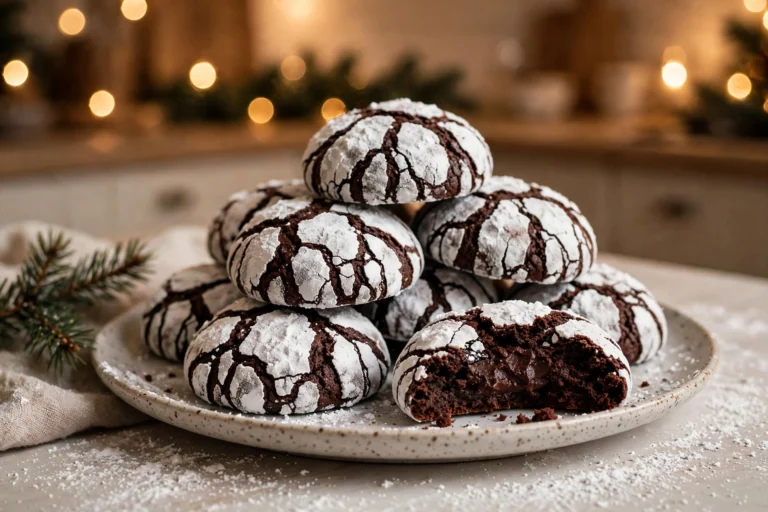
25-Minute Chocolate Crinkle Cookies
Chocolate crinkle cookies with no refrigerator step: a stiff, cocoa rich dough built to roll right away, a 5 minute counter rest instead of a chill, and a double sugar roll (granulated first, then powdered) for bold snowy cracks and fudgy, brownie like centers. Bowl to cooling rack in 25 minutes.
- Total Time: 25 minutes
- Yield: 24 cookies 1x
Ingredients
- 1/4 cup unsalted butter (half a stick), melted and cooled for 2 minutes
- 1 cup granulated sugar, plus 1/4 cup more for rolling
- 1/2 cup unsweetened cocoa powder, Dutch process for the darkest color
- 2 large eggs, at room temperature
- 1 teaspoon vanilla extract
- 1 1/4 cups all-purpose flour, spooned and leveled
- 1 teaspoon baking powder
- 1/4 teaspoon fine sea salt
- 1/2 cup mini chocolate chips (optional)
- 3/4 cup powdered sugar, for rolling
Instructions
- Heat the oven to 350°F (175°C). Line two baking sheets with parchment. Put the 1/4 cup granulated sugar in one shallow bowl and the powdered sugar in another.
- Whisk the melted butter, the 1 cup granulated sugar and the cocoa powder in a large bowl into a thick, glossy paste, about 1 minute.
- Whisk in the eggs one at a time, then the vanilla, until the mixture loosens into a thick, shiny batter.
- Fold in the flour, baking powder and salt just until no dry streaks remain, then fold in the mini chocolate chips if using.
- Rest the dough for 5 minutes on the counter while the oven finishes heating; it will firm up enough to roll. There is no refrigerator step.
- Scoop tablespoon sized portions and roll into balls. Roll each ball first in granulated sugar to coat completely, then generously in powdered sugar until it looks like a snowball.
- Arrange the balls 2 inches apart on the prepared sheets. Bake one sheet at a time for 10 to 11 minutes, until the tops are crackled, the edges look set and the centers still appear soft and slightly shiny.
- Cool on the pan for 5 minutes so the centers set fudgy, then move to a rack.
- Prep Time: 14 minutes
- Cook Time: 11 minutes
Nutrition
- Calories: 105
- Sugar: 12
- Sodium: 55
- Fat: 4
- Saturated Fat: 2
- Carbohydrates: 17
- Fiber: 1
- Protein: 2
- Cholesterol: 20