
In this article:
- Real eggnog in the dough, not a rumor of it
- Soft centers under a crackled spiced shell
- The rolling sugar: cinnamon first, nutmeg last
- The no chill balance, measured for eggnog
- Ingredients
- Mixing, rolling and baking the eggnog snickerdoodles
- A two minute eggnog glaze for the fancy tin
- Flat, smooth or tough: reading your first sheet
- Freeze the sugared balls now, bake all December
- Keeping snickerdoodles soft in the cookie box
- Questions about these eggnog snickerdoodles
Real Eggnog in the Dough, Not a Rumor of It
These eggnog snickerdoodles carry a quarter cup of real eggnog in the dough, and you can taste it: custard richness under the cinnamon, nutmeg blooming at the finish. No extracts standing in for the drink, no creamer shortcuts.
Half the recipes on the internet skip the eggnog entirely and season a plain snickerdoodle, then call it a day. The flavor lands flat because snickerdoodle dough is mild by design; it needs the eggnog’s custard base to become the holiday cookie its name promises.
The cream of tartar stays, because it is the snickerdoodle signature. It gives the gentle tang and the tender, almost pillowy crumb that separates a snickerdoodle from a sugar cookie in a cinnamon coat.
And the whole batch, mixing bowl to cooling rack, takes 25 minutes. The dough is balanced to roll immediately, so the hour of chilling other recipes demand simply never appears on your schedule.
Eggnog snickerdoodles are the cookie I bake when the first carton of eggnog lands in the fridge and the house needs to smell like December within the half hour.
They come out of the oven pale and puffed, wearing a crackled shell of cinnamon sugar, smelling like the drink itself got warm and spiced in the best way. One bite is soft all the way through, with edges that barely crisp.
The mug test never fails: dunk one in a glass of cold eggnog and the cookie drinks it up without falling apart. That is the texture this recipe is tuned for, tender with structure.
Bake them for the cookie box, the office tray, or the neighbor plate. They travel well, stack neatly, and taste like the season without a single drop of anything stronger than nutmeg.
There is also a quieter pleasure in this recipe: it is a one bowl afternoon for a young baker. Rolling balls in spiced sugar is the kind of job small hands take seriously, and the crackled tops forgive uneven rolling completely.
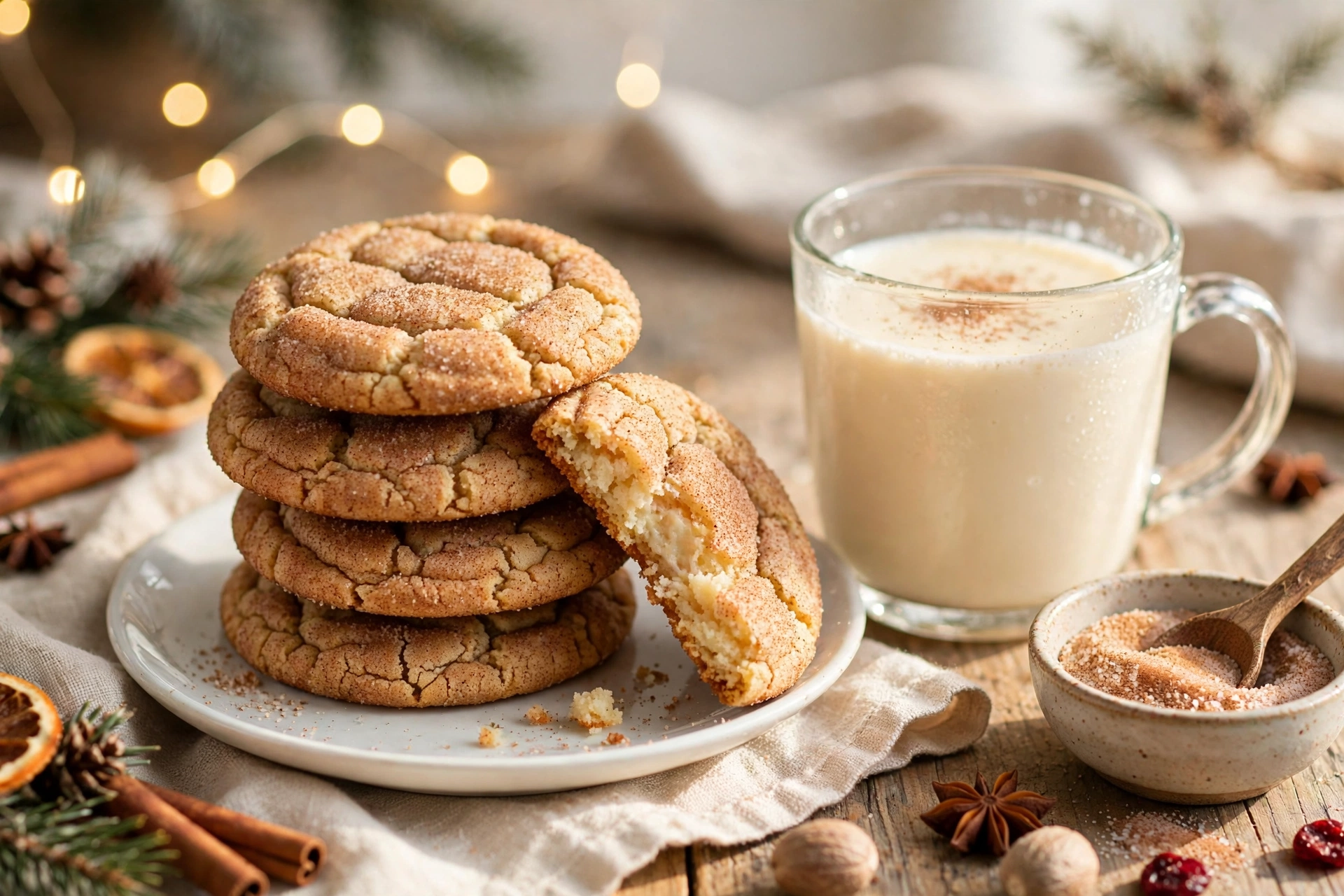
Soft Centers Under a Crackled Spiced Shell
A great snickerdoodle is a study in two textures. The shell is thin, dry and crackled, a spiced sugar crust that shatters softly; the center is pale, moist and almost cakey, with no crispness past the first millimeter.
The crackle is not decoration, it is a timing record. As the cookie puffs in the heat, the sugared surface dries and splits into pale islands separated by darker seams of spice.
Brown sugar is the quiet engineer of the soft center. Its molasses holds moisture through baking and into storage, which is why these cookies stay tender on day three instead of turning to croutons.
The eggnog changes the crumb in a way milk cannot. Its yolks and cream enrich the dough, so the center reads custardy, closer to a soft French pastry than to a plain sugar cookie.
Pull the sheet when the centers still look slightly underdone and glossy in the cracks. The cookies finish on the hot pan, and that last soft minute is the difference between pillowy and dry.
Served warm, the nutmeg reads first, then cinnamon, then the vanilla custard underneath. Served cold the next day, the spices settle and the eggnog flavor actually deepens.
The Rolling Sugar: Cinnamon First, Nutmeg Last
The coating is a two spice system, and the order in your bowl matters less than the ratio. Cinnamon does the broad, warm work; nutmeg is the high note that makes people say the word eggnog before you do.
Use 1 1/2 teaspoons of cinnamon and 1/2 teaspoon of nutmeg to a quarter cup of sugar. More nutmeg than that turns medicinal fast, and fresh grated nutmeg needs even less, about half the amount.
Roll generously, then roll again. A ball that goes into the oven half coated bakes up patchy, because the dough expands and stretches the sugar layer thin as it puffs.
The second pass takes ten seconds per ball and pays off in a shell that crackles evenly edge to edge. Shake off only the loose excess; the cracks need that sugar to form.
Save the leftover spiced sugar. It is extraordinary on buttered toast, in coffee, or over the whipped cream on a mug of our 20 minute homemade eggnog if you make your own batch.
One more use: a pinch sprinkled over the baked cookies while they are still warm doubles down on the aroma. The heat wakes the nutmeg up right before serving.
The No Chill Balance, Measured for Eggnog
Most eggnog snickerdoodles demand an hour in the fridge because their doughs are wet. Eggnog is mostly milk, and a careless quarter cup turns cookie dough into something closer to batter.
This recipe answers with measurement instead of waiting. The eggnog stays at 1/4 cup, the flour is a full 2 1/4 cups spooned and leveled, and one egg, not two, keeps the liquid budget honest.
The butter matters as much as the math. Soft enough to cream, cool enough to hold its shape: if it shines or slumps, the dough will spread no matter what the flour does.
The result rolls into smooth balls the moment the flour disappears. No stickiness on the palms, no flour dusting needed, no hour lost to the refrigerator.
If your kitchen is very warm, a 10 minute rest for the filled sheet while the oven heats is insurance, not a requirement. The first sheet will tell you whether you needed it.
That no chill structure is what lets two sheets relay through the oven inside 25 minutes, the same relay that keeps the tin full in our Christmas spritz cookies production.
Ingredients
- 1/2 cup unsalted butter, softened but cool
- 3/4 cup granulated sugar
- 1/4 cup packed light brown sugar
- 1 large egg, at room temperature
- 1/4 cup eggnog, well shaken
- 1 teaspoon pure vanilla extract
- 2 1/4 cups all-purpose flour, spooned and leveled
- 1 teaspoon cream of tartar
- 1/2 teaspoon baking soda
- 1/2 teaspoon fine sea salt
- 1/2 teaspoon ground nutmeg, for the dough
- 1/4 cup granulated sugar, for rolling
- 1 1/2 teaspoons ground cinnamon, for rolling
- 1/2 teaspoon ground nutmeg, for rolling
- 1/2 cup powdered sugar, for the optional glaze
- 2 tablespoons eggnog, for the optional glaze
Mixing, Rolling and Baking the Eggnog Snickerdoodles
- Heat the oven to 350 degrees F. Line two baking sheets with parchment paper.
- Beat the butter, granulated sugar and brown sugar in a large bowl until pale and fluffy, about 2 minutes.
- Beat in the egg, eggnog and vanilla until smooth and glossy, scraping the bowl once.
- Whisk the flour, cream of tartar, baking soda, salt and nutmeg in a second bowl. Add to the butter mixture and mix on low just until a soft dough forms.
- Stir the rolling sugar, cinnamon and nutmeg together in a shallow bowl.
- Scoop 1 1/2 tablespoon portions, roll into smooth balls, and coat each one generously in the spiced sugar, twice for an even shell.
- Place the balls 2 inches apart on the first sheet and bake for 9 to 11 minutes, until the edges are set and the centers still look slightly soft. Roll the second sheet while the first bakes.
- Cool the cookies on the sheet for 5 minutes, where the crackles deepen, then move them to a rack. Bake the second sheet the same way.
- For the optional glaze, whisk the powdered sugar with the eggnog to a drizzling consistency, drizzle over the cooled cookies, and let it set for 10 minutes.
A Two Minute Eggnog Glaze for the Fancy Tin
The glaze is optional in the way good jewelry is optional. The cookies are complete without it, but a thin drizzle of eggnog icing turns a rustic crackle into a bakery finish.
Whisk it thick, not runny: it should fall from the spoon in a slow ribbon and hold its line on the cookie for a few seconds before settling. Too thin and it vanishes into the cracks.
Drizzle from a fork or a small zip bag with the corner snipped, moving in quick zigzags. A fine dusting of nutmeg over the wet glaze sets the pattern and sharpens the aroma.
Let glazed cookies set a full 10 minutes before stacking. The glaze firms to a matte shell that survives the cookie box, which is the whole point of the fancy tin.
Glaze only the cookies you plan to show off. Unglazed ones freeze and reheat better, and some of us prefer the plain crackle with coffee anyway.
Flat, Smooth or Tough: Reading Your First Sheet
The first sheet is a diagnostic tool. Bake it, read it, and adjust before the second sheet goes in, because every variable shows itself in the first twelve cookies.
Flat and greasy means the butter was too warm or the flour was scooped light. Chill the remaining dough for 10 minutes and add a tablespoon of flour to the last balls if they feel slack.
Smooth tops with no crackle mean the coating was thin or the oven was not fully hot. Recoat the next batch with a firmer second roll, and give the oven five more minutes to truly reach temperature.
Tough or bready cookies point to overmixing after the flour went in. There is no rescue for that batch beyond a longer dunk, but the next bowl wants 20 seconds of mixing, not a minute.
Pale and puffy with raw centers means the balls were too big. Drop to a level 1 1/2 tablespoon scoop and keep the 2 inch spacing, which the spread genuinely needs.
Dark bottoms on pale tops call for the middle rack and a lighter colored sheet. Dark pans bake snickerdoodles a full shade deeper on the base at the same setting.
Freeze the Sugared Balls Now, Bake All December
This dough was built for the freezer, which makes it the hardest working cookie of the season. Roll and coat the balls, freeze them solid on a sheet, then bag them for up to 1 month.
Bake from frozen at the same 350 degrees F with 2 extra minutes. The crackle forms exactly the same, because the sugar coat goes on before freezing, not after.
That rhythm turns cookie season into a standing offer: guests at seven, warm eggnog snickerdoodles at seven twenty five, no mixing bowl involved.
Baked cookies freeze too, unglazed, for the same month. Thaw them in the closed container so the moisture returns to the crumb instead of the air.
In the gift tin, pair them with something dark and spiced for contrast. Our soft molasses cookies and gingerbread crinkle cookies make the pale snickerdoodles look even more festive.
Keeping Snickerdoodles Soft in the Cookie Box
Softness is a storage problem, not a baking one. Airtight is the whole law: a sealed tin or container, parchment between layers, and the box kept at room temperature, never in the fridge.
The old bread trick earns its reputation here. A small piece of sandwich bread in the container gives its moisture to the cookies over 24 hours and keeps the centers tender for 4 days.
A 5 second pass in the microwave returns a day three cookie to something close to fresh baked. Serve it immediately; the softness window is about 2 minutes and worth every one.
The snickerdoodle has been an American bakery staple since the late 1800s, as the history of the snickerdoodle records, and it has survived every era by being exactly this: simple, spiced and soft.
Box them beside crisp cookies only if the layers are separated. Like our Christmas sugar cookie bars, they trade moisture with their neighbors and everyone ends up average.
Questions About These Eggnog Snickerdoodles
Can I make eggnog snickerdoodles without cream of tartar?
You can replace the cream of tartar and baking soda together with 1 1/2 teaspoons of baking powder. The cookies bake up fine, but they lose the faint tang and some tenderness that make a snickerdoodle a snickerdoodle.
Does the eggnog need to be homemade?
No. A good store bought eggnog from the dairy case works perfectly and keeps the recipe at 25 minutes. Shake the carton well before measuring, because the spices settle at the bottom.
Why did my snickerdoodles come out flat?
Warm butter, light flour or an underheated oven are the usual three causes. Butter should hold a fingerprint without shining, flour should be spooned and leveled, and 10 minutes of chilling rescues a warm kitchen dough.
Can I freeze the dough balls for the cookie box week?
Yes, and it is the best way to run December. Freeze the coated balls on a sheet, bag them for up to 1 month, and bake from frozen at 350 degrees F with 2 extra minutes.
How long do eggnog snickerdoodles stay soft?
Four days in an airtight container with a small piece of bread sharing the box. The brown sugar and eggnog keep the centers tender, and a 5 second microwave pass revives them after that.
Eggnog Snickerdoodles
Eggnog snickerdoodles in 25 minutes with real eggnog in the dough, no chilling, a cinnamon and nutmeg rolling sugar, and crackled tops. An optional two minute eggnog glaze finishes the fancy tin, and the sugared dough balls freeze for a month.
- Total Time: 25 minutes
- Yield: 24 cookies 1x
Ingredients
- 1/2 cup unsalted butter, softened but cool
- 3/4 cup granulated sugar
- 1/4 cup packed light brown sugar
- 1 large egg, at room temperature
- 1/4 cup eggnog, well shaken
- 1 teaspoon pure vanilla extract
- 2 1/4 cups all-purpose flour, spooned and leveled
- 1 teaspoon cream of tartar
- 1/2 teaspoon baking soda
- 1/2 teaspoon fine sea salt
- 1/2 teaspoon ground nutmeg, for the dough
- 1/4 cup granulated sugar, for rolling
- 1 1/2 teaspoons ground cinnamon, for rolling
- 1/2 teaspoon ground nutmeg, for rolling
- 1/2 cup powdered sugar, for the optional glaze
- 2 tablespoons eggnog, for the optional glaze
Instructions
- Heat the oven to 350 degrees F and line two baking sheets with parchment.
- Beat the butter, granulated sugar and brown sugar until pale and fluffy, about 2 minutes.
- Beat in the egg, eggnog and vanilla until smooth and glossy.
- Whisk the flour, cream of tartar, baking soda, salt and nutmeg, then mix into the butter mixture on low just until a soft dough forms.
- Stir the rolling sugar, cinnamon and nutmeg in a shallow bowl.
- Scoop 1 1/2 tablespoon balls, roll smooth, and coat generously in the spiced sugar, twice for an even shell.
- Bake the first sheet 9 to 11 minutes, until the edges are set and the centers still look slightly soft. Roll the second sheet meanwhile.
- Cool 5 minutes on the sheet, then move to a rack and bake the second sheet the same way.
- For the optional glaze, whisk the powdered sugar with the eggnog, drizzle over the cooled cookies, and let set 10 minutes.
- Prep Time: 14 minutes
- Cook Time: 11 minutes
Nutrition
- Serving Size: 1
- Calories: 135
- Sugar: 12
- Sodium: 70
- Fat: 5
- Saturated Fat: 3
- Unsaturated Fat: 2
- Trans Fat: 0
- Carbohydrates: 21
- Fiber: 0
- Protein: 1
- Cholesterol: 20