
In this article:
- Why These Gingerbread Crinkle Cookies Need No Chill at All
- Crackled Snow on a Chewy Molasses Heart
- Twenty-Five Minutes, Freezer Trick Included
- Ingredients for Gingerbread Crinkle Cookies
- Mix, Freeze, Double-Coat, Bake: Four Moves
- The Double Sugar Coat That Makes the Cracks
- Fixes for Faded Cracks, Flat Cookies and Pale Tops
- Spice Twists, a Chocolate Finish and a Gluten-Free Batch
- Doubling the Batch for a Cookie Exchange
- Keeping Crinkles Bold for a Week
- The Cookie Tin That Empties First
- FAQ
Why These Gingerbread Crinkle Cookies Need No Chill at All
Gingerbread crinkle cookies usually demand an hour or two of refrigeration, and that wait is exactly what this recipe removes. Melted butter replaces creamed butter, so there is no softening, no mixer workout and no pale, overworked dough.
A single tablespoon of cornstarch does the quiet structural work. It drinks up the extra moisture from the melted butter and molasses, firms the dough in minutes and keeps the centers chewy instead of cakey.
The short rest happens after shaping, not before. Rolled balls spend ten minutes in the freezer while the oven heats, arriving at the sugar bowls cold enough to hold a thick coat and a proud dome.
Nothing here is a shortcut that costs flavor. Dark brown sugar and unsulphured molasses still deliver the deep, almost smoky sweetness, and the spice blend stays bold: ginger in front, cinnamon behind, cloves at the edges.
There is also a quiet economy to the method. One bowl, one whisk, no stand mixer to wash, and a batch sized for real life: two dozen cookies, enough for a tin on the counter and a plate to give away.
Gingerbread crinkle cookies are the first tray I bake when the cookie exchange invitations land, because nothing on the table photographs like them. Snowy white cracks split across a dark spiced dome, and the whole plate looks like it took an afternoon.
The bite is the real surprise. The crust gives a faint snap, then the center stays soft and chewy for days, dense with molasses and warm spice. One cookie perfumes the tin; a dozen perfume the whole kitchen.
Crackled Snow on a Chewy Molasses Heart
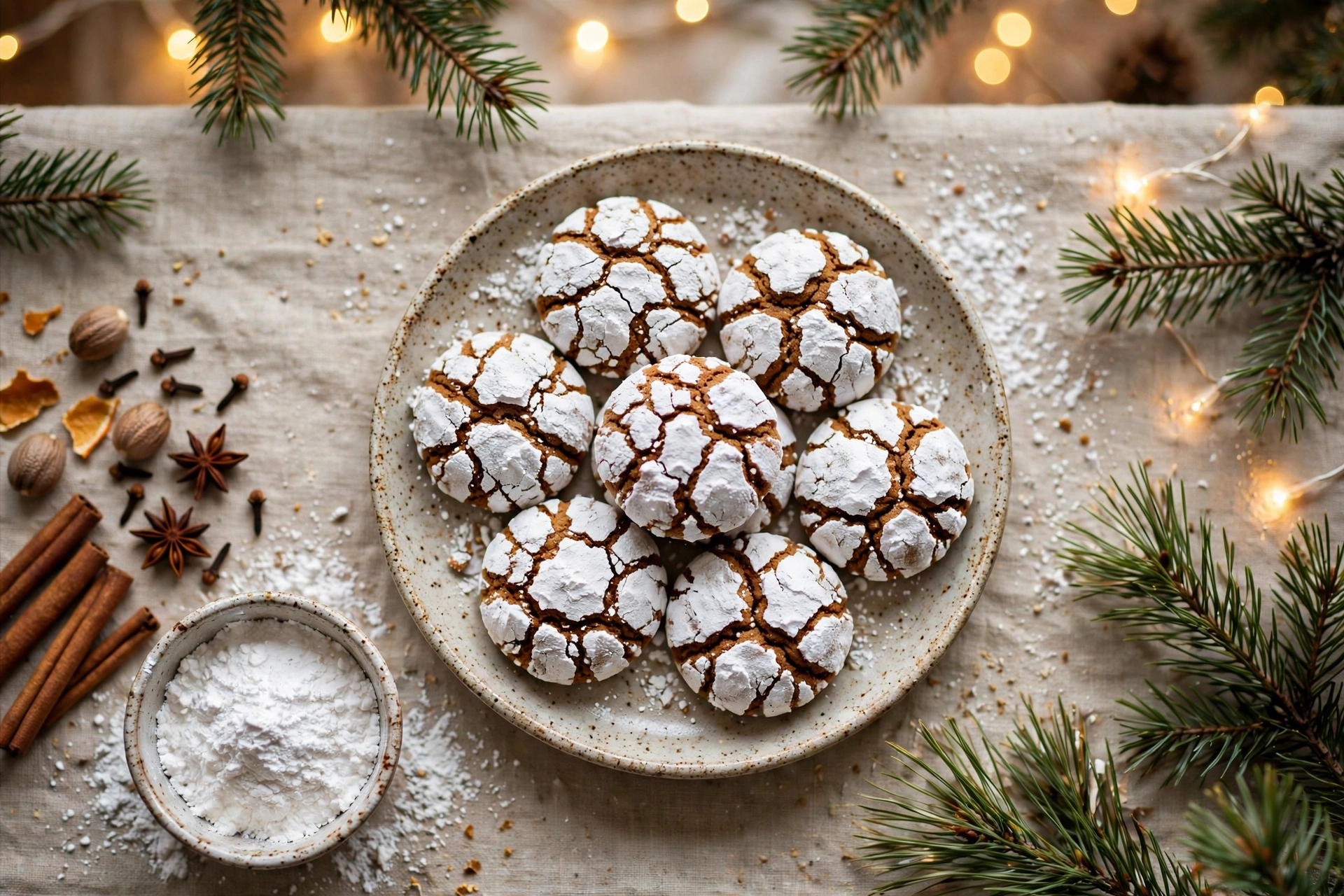
The contrast starts with your eyes. Powdered sugar stays chalk white in wide drifts while the cracks open into dark, glossy lanes of spiced dough, so every cookie looks slightly different and entirely handmade.
Ginger leads the flavor and arrives warm rather than hot. Cinnamon rounds it out, cloves add a quiet depth at the finish, and a small measure of nutmeg bridges the spices into one warm blend.
Molasses is the backbone. Its bitterness keeps the cookie from tasting flatly sweet, the way a plain sugar cookie can, and it gives the crumb that deep mahogany color the white coat needs.
Texture is a three part story. A delicate crisp at the rim, a soft chew through the middle, and the faintest sugar crunch on the surface where the granulated layer sits under the powdered coat.
Served slightly warm, the centers lean almost fudgy. At room temperature they settle into the classic chew that makes crinkles the cookie people reach for twice.
The aroma deserves its own sentence. Baking releases the ginger first, then the molasses turns deeper and almost caramelized at the edges of the kitchen, the smell that tells everyone within two rooms that December baking has started.
Size plays a role in that texture. A ball of about one and a half tablespoons gives a cookie wide enough for a chewy middle yet small enough to finish in four bites, the right scale for a mixed cookie plate.
There is also a pleasing patience built into eating one. The sugar coat dissolves first, then the spice arrives, then the molasses chew lingers, so a single cookie delivers three distinct moments instead of one flat sweetness.
Twenty-Five Minutes, Freezer Trick Included
The clock is honest here: fifteen minutes of preparation, ten minutes in the oven, twenty five minutes total. The freezer rest hides inside the oven preheat, so not one minute is spent watching a bowl sit.
Because the dough mixes by hand in one bowl, cleanup is a whisk, a spatula and a measuring cup. The second bowl holds only sugar, and it goes straight back into the cupboard.
This timing makes the recipe a weeknight cookie, not a weekend project. Start after dinner and a warm tray is on the table before the dishes are done, with the kitchen smelling like December.
The schedule also scales gracefully to a party deadline. Mix a double batch in the same bowl, freeze the balls on two trays, and bake the sheets back to back; the second tray waits in the freezer, perfectly coated.
Ingredients for Gingerbread Crinkle Cookies
- 2 1/4 cups (280 g) all-purpose flour
- 1 tablespoon cornstarch
- 2 teaspoons ground ginger
- 1 1/2 teaspoons ground cinnamon
- 1/4 teaspoon ground cloves
- 1/4 teaspoon ground nutmeg
- 1 teaspoon baking soda
- 1/2 teaspoon fine sea salt
- 1/2 cup (115 g) unsalted butter, melted and slightly cooled
- 3/4 cup (150 g) packed dark brown sugar
- 1/3 cup (110 g) unsulphured molasses
- 1 large egg, at room temperature
- 1 teaspoon pure vanilla extract
- 1/3 cup (65 g) granulated sugar, for rolling
- 3/4 cup (90 g) powdered sugar, sifted, for rolling
Dark brown sugar matters more than it looks. Its extra molasses deepens both the color and the chew, while light brown sugar gives a paler cookie with a gentler spice shadow.
Spice freshness is the other quiet lever. Ground ginger loses its warmth after about six months in the cupboard, so a fresh jar transforms the batch. Molasses, beyond flavor, carries small amounts of iron, calcium and potassium, as the USDA FoodData Central listings show.
Mix, Freeze, Double-Coat, Bake: Four Moves
- Heat the oven to 350°F (175°C) and line two baking sheets with parchment. Whisk the flour, cornstarch, ginger, cinnamon, cloves, nutmeg, baking soda and salt in a medium bowl until evenly blended.
- Whisk the melted butter, dark brown sugar and molasses in a large bowl until glossy, about 30 seconds. Whisk in the egg and vanilla until the mixture looks like thick caramel.
- Fold the dry ingredients into the wet with a spatula until a soft, shiny dough forms and no dry streaks remain, about 1 minute. The dough will be soft, and that is correct.
- Scoop 24 balls of about 1 1/2 tablespoons each and roll them smooth between your palms. Set them on a parchment lined plate and freeze for 10 minutes while the oven finishes heating.
- Roll each cold ball first in granulated sugar, then generously in powdered sugar, coating every side thickly. Arrange on the prepared sheets, 2 inches apart.
- Bake one sheet at a time for 10 to 11 minutes, until the tops are boldly cracked, the edges look set and the centers still appear slightly soft.
- Cool on the sheet for 5 minutes, where the centers finish setting, then move to a wire rack. Serve warm or at room temperature.
One practical note on the sheets: bake the trays one at a time in the center of the oven. Crowding both levels traps steam, softens the sugar coat and blurs the very cracks this recipe works to create.
The Double Sugar Coat That Makes the Cracks
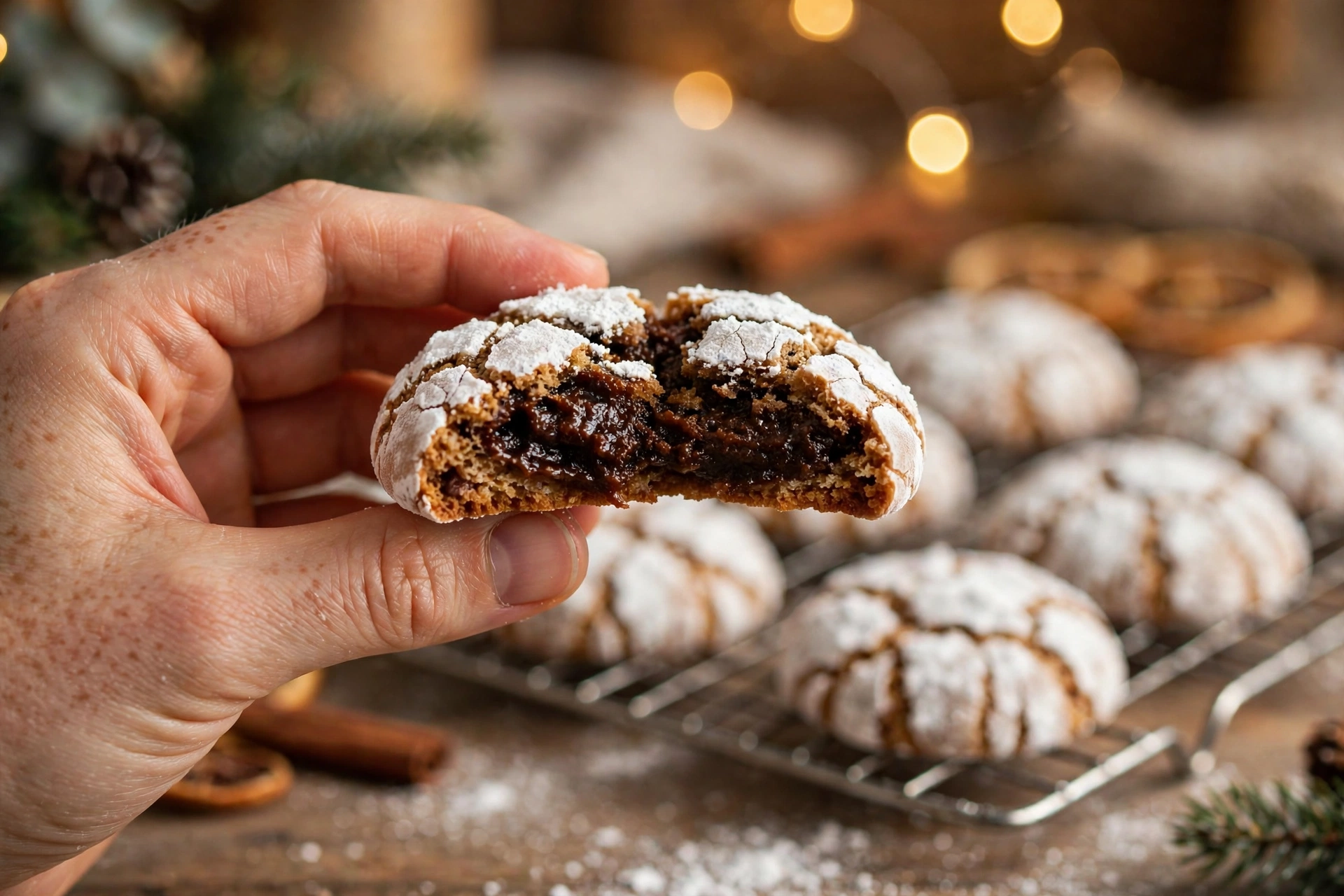
Every batch of gingerbread crinkle cookies lives or dies on this coating, and the order is the mechanism. Granulated sugar goes on first because its coarse crystals form a dry barrier between the moist dough and the powdered layer.
Without that barrier, the powdered sugar drinks moisture from the dough as it bakes, melts into gray patches and the famous cracks never appear. With it, the white coat stays dry, brittle and bright.
As the cookie spreads in the heat, the brittle coat cannot stretch, so it splits along fault lines while the dark dough rises through the gaps. That split is the crinkle, and the freezer cold dough slows the spread so the pattern opens wide instead of washing flat.
Be generous to the point of excess. A timid dusting gives polite little lines; a thick, almost shaggy coat gives the bold snowdrift cracks that make the plate look bakery made.
The same logic explains why the balls are coated after freezing rather than before. Cold dough grabs the sugars and holds them in a thick, even layer, while warm dough sheens with butter and lets the coat slide into patches.
Fixes for Faded Cracks, Flat Cookies and Pale Tops
If the cracks faded, the balls were too warm or the coat too thin. Chill the shaped balls the full ten minutes, and roll the powdered sugar on until no brown shows through anywhere.
Flat cookies point to an oven that had not finished heating or butter that went in hot enough to cook the egg. Melted butter should feel warm, never steaming, and the first tray waits for the full preheat.
Pale tops usually mean the powdered sugar was stale and clumped, so it coated in patches. Sift it fresh, press the balls gently into the bowl as you roll, and the white will sit in an even blanket.
Centers that stay raw while the edges darken need smaller balls, not more time. Keep each ball near 1 1/2 tablespoons, and the ten minute bake stays accurate from batch to batch.
If a whole tray leans pale, suspect the powdered sugar bowl, not the oven. Humidity clumps the sugar and dulls its color; a fresh sifted bowl and dry hands restore the bright white in the next batch instantly.
Spice Twists, a Chocolate Finish and a Gluten-Free Batch
For a warmer profile, add 1/4 teaspoon of black pepper or a pinch of cayenne with the spices. The heat hides behind the ginger and makes the molasses taste deeper without turning the cookie spicy.
A chocolate finish suits a gifting tray: dip half of each cooled cookie in melted dark chocolate and let it set on parchment. The bitter edge plays beautifully against the sweet crackled top.
Orange zest, one teaspoon finely grated into the wet ingredients, brightens the whole batch and leans the flavor toward a holiday market stall. A few flakes of sea salt on top before baking do the same in a savory direction.
For a gluten-free batch, swap the flour for a cup for cup gluten-free blend that contains xanthan gum, and rest the shaped balls the full ten minutes. The cracks open slightly wider, the chew stays intact.
Dairy-free bakers can use a plant butter stick with a similar fat content. Choose one that melts cleanly, since very soft tubs make the dough slack and the cookies spread thin.
A sandwich variation travels well to exchanges: press a thin layer of cream cheese frosting between two cookies and chill briefly. The tang against the warm spice tastes like a miniature holiday cake, and the cracks still show on top.
Doubling the Batch for a Cookie Exchange
A double batch needs no new technique, only a wider bowl for coating. The sugars deplete faster than expected when forty eight balls pass through, so keep the granulated and powdered bowls topped up rather than letting the last balls roll in dust.
Work in waves of twelve: roll, freeze, coat, bake. While one tray bakes, the next wave freezes, and the rhythm keeps every ball cold and every coat thick without a single pause in the oven schedule.
Packaging is the last detail for an exchange. Let the cookies cool fully before boxing, since trapped warmth steams the sugar coat; a sheet of parchment between layers keeps the white tops print perfect on arrival.
Building a bigger exchange box? Round it out with our cranberry orange shortbread cookies, which freeze and travel just as gracefully.
Keeping Crinkles Bold for a Week
Gingerbread crinkle cookies keep their chew for five days in a sealed tin at room temperature, layered between sheets of parchment so the snowy tops do not rub against each other.
The white coat slowly absorbs moisture from day three, so the cracks soften from chalk bright to a gentle matte. The flavor, meanwhile, improves: the spices meld and the molasses edge mellows into the crumb.
For longer keeping, freeze the coated raw balls on a tray, then bag them for up to two months. Bake from frozen at the same temperature, adding one to two minutes, and the cracks open as boldly as fresh.
Planning the whole holiday table around them? Our guide to the best Christmas Eve finger food ideas covers the savory bites that sit beside the cookie tin.
Baked cookies also freeze well for a month. Thaw them in the closed container so condensation lands on the tin rather than the sugar coat, and they will look freshly dusted.
For gifting, the tin matters less than the timing: pack them the day after baking, when the chew has settled and the spice has mellowed, and include a small card with the bake date so the exchange host serves them at their best.
The Cookie Tin That Empties First
Gingerbread crinkle cookies carry the whole season in one bite: dark spice, deep molasses, a snowy crackled top and a center that stays chewy for days. This no chill version puts them twenty five minutes from a craving, any night of the week.
Mix the dough, freeze the balls while the oven heats, and be generous with the double sugar coat. The tray that comes out looks like it took all afternoon, and only you will know the clock.
FAQ
Do gingerbread crinkle cookies really work with no chilling time?
Yes, with two adjustments: melted butter plus a tablespoon of cornstarch keeps the soft dough workable, and the shaped balls rest 10 minutes in the freezer while the oven heats. That short freeze on the balls, rather than a long chill on the bowl, is enough for thick coats and bold cracks.
Why roll the balls in granulated sugar before powdered sugar?
The granulated sugar is a dry barrier. It stops the powdered sugar from absorbing moisture from the dough and melting into gray patches, so the white coat stays brittle, splits into wide cracks and keeps its snowy color.
Can I freeze gingerbread crinkle cookie dough balls?
Yes, and it is the best make ahead route. Coat the balls in both sugars, freeze them solid on a tray, then bag for up to 2 months. Bake from frozen at 350°F, adding 1 to 2 minutes to the bake.
What can I use instead of molasses?
Dark corn syrup or honey can stand in by volume, but the flavor changes: honey makes a lighter, floral cookie and the crumb loses its deep mahogany color. For the true gingerbread taste, unsulphured molasses is worth keeping.
Why did the powdered sugar disappear on my cookies?
Three usual causes: the coat was too thin, the dough balls were warm so the sugar melted on contact, or the granulated sugar layer was skipped. Chill the balls the full 10 minutes and coat until no brown shows through.
Gingerbread Crinkle Cookies
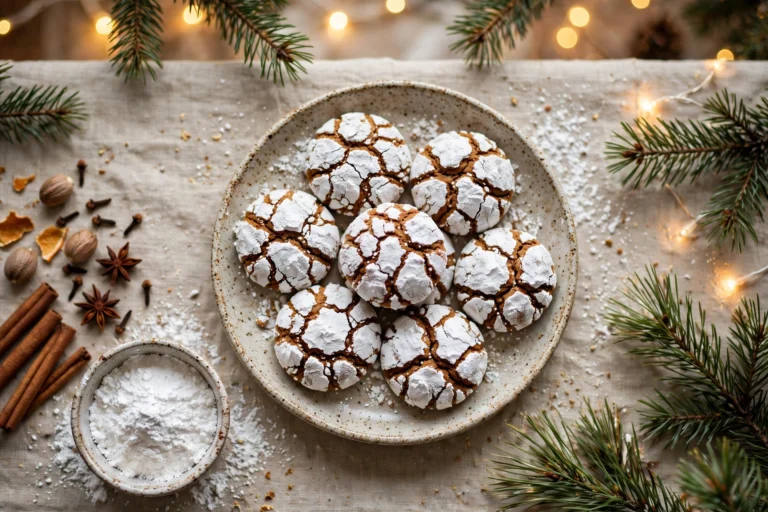
No chill gingerbread crinkle cookies ready in 25 minutes: a melted butter and molasses dough firmed with cornstarch, shaped balls rested 10 minutes in the freezer while the oven heats, then rolled in granulated sugar and powdered sugar for bold snowy cracks and a chewy center.
- Total Time: 25 minutes
- Yield: 24 cookies 1x
Ingredients
- 2 1/4 cups (280 g) all-purpose flour
- 1 tablespoon cornstarch
- 2 teaspoons ground ginger
- 1 1/2 teaspoons ground cinnamon
- 1/4 teaspoon ground cloves
- 1/4 teaspoon ground nutmeg
- 1 teaspoon baking soda
- 1/2 teaspoon fine sea salt
- 1/2 cup (115 g) unsalted butter, melted and slightly cooled
- 3/4 cup (150 g) packed dark brown sugar
- 1/3 cup (110 g) unsulphured molasses
- 1 large egg, at room temperature
- 1 teaspoon pure vanilla extract
- 1/3 cup (65 g) granulated sugar, for rolling
- 3/4 cup (90 g) powdered sugar, sifted, for rolling
Instructions
- Heat the oven to 350°F (175°C) and line two baking sheets with parchment. Whisk the flour, cornstarch, ginger, cinnamon, cloves, nutmeg, baking soda and salt in a medium bowl.
- Whisk the melted butter, dark brown sugar and molasses in a large bowl until glossy, about 30 seconds. Whisk in the egg and vanilla until the mixture looks like thick caramel.
- Fold the dry ingredients into the wet with a spatula until a soft, shiny dough forms and no dry streaks remain, about 1 minute.
- Scoop 24 balls of about 1 1/2 tablespoons each and roll smooth. Set on a parchment lined plate and freeze 10 minutes while the oven finishes heating.
- Roll each cold ball first in granulated sugar, then generously in powdered sugar, coating every side thickly. Arrange on the prepared sheets, 2 inches apart.
- Bake one sheet at a time for 10 to 11 minutes, until the tops are boldly cracked, the edges look set and the centers still appear slightly soft.
- Cool on the sheet for 5 minutes, then move to a wire rack. Serve warm or at room temperature.
- Prep Time: 15 minutes
- Cook Time: 10 minutes
2 commentaires sur « 25-Minute Gingerbread Crinkle Cookies (No Chill, Bold Cracks) »