
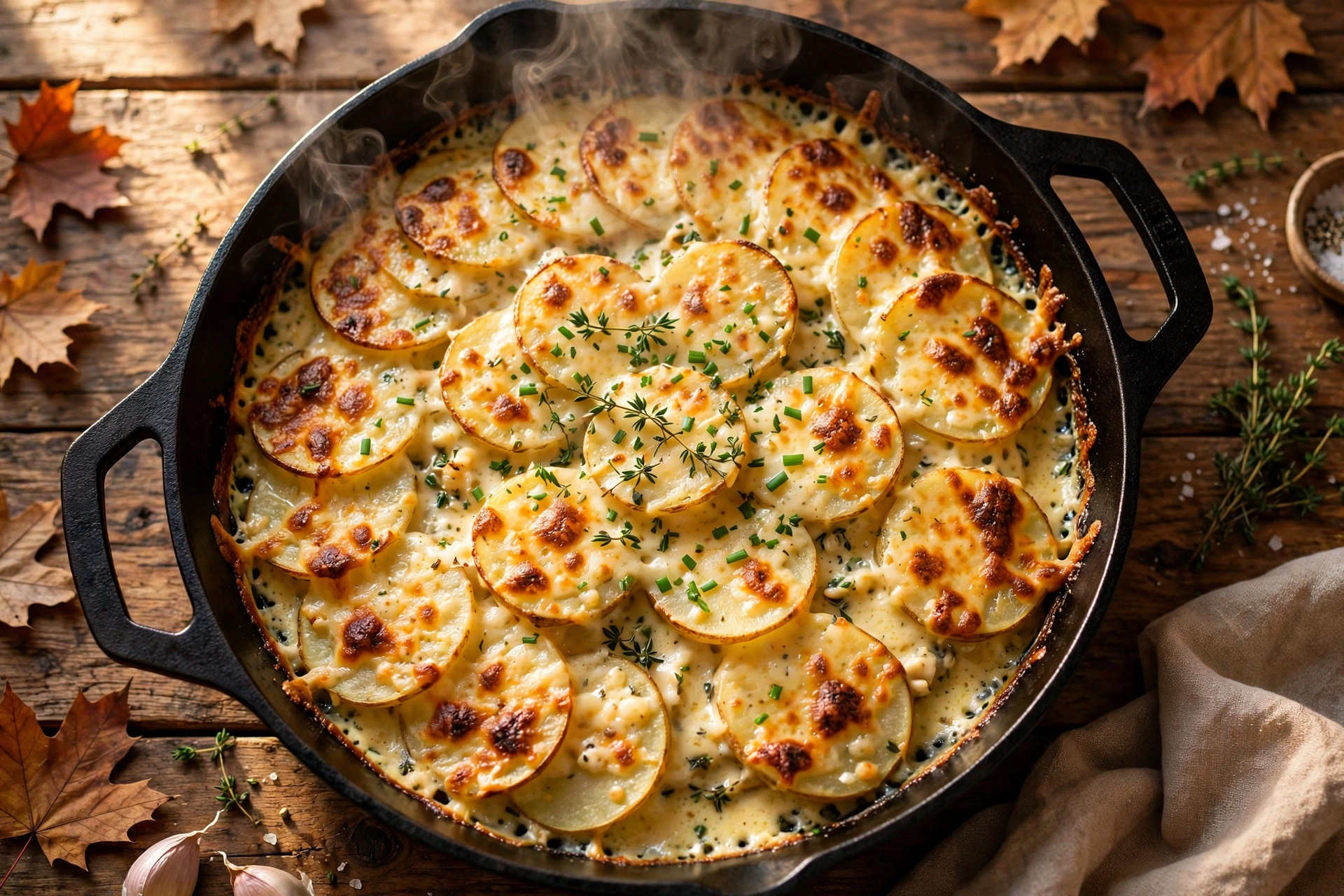
Classic scalloped potatoes ask for the one thing Thanksgiving never has: an hour and a half of free oven. The turkey is in there. The rolls want in next. So the most requested potato dish on the table quietly gets skipped, year after year, by cooks who love it. These stovetop scalloped potatoes end that story. Thin potato slices simmer directly in a garlic thyme cream sauce in one big skillet, right on the burner, and finish with a two minute broil that gives them the golden cheese top everyone thinks takes an hour of baking. Thirty minutes, one pan, eight generous servings, and the oven never gets involved until the very end, if at all.
The system is simple: slice thickness decides the cooking time, the sauce is made in the same skillet, and the cheese top is a finish, not a cooking stage. Read the thickness chart before you start, because it sets your simmer time to the minute.
Jump to:
- The Hour Long Bake Was the Only Problem
- Thin Slices Are the Whole Speed System
- What You Need
- Stovetop Scalloped Potatoes, Step by Step
- The Two Minute Broil That Fakes an Hour of Baking
- Slice Thickness Versus Simmer Time
- A Sauce That Never Breaks
- Thanksgiving Clock: Hold, Reheat, Serve
- Leftovers Worth Planning For
- Questions About These Stovetop Scalloped Potatoes
The Hour Long Bake Was the Only Problem
Be honest about what the baked version costs. Sliced potatoes layered in a dish, covered, baked forty five minutes, uncovered, baked thirty five more. That is eighty minutes of oven for a side dish, on the one day the oven runs a full shift. Something always loses, and it is usually the scalloped potatoes, because mashed potatoes can happen entirely on the stove. Cooks are not wrong to skip them. The method is wrong for the day.
The stovetop version keeps everything people love and moves the work to a burner. The potatoes still cook in cream until they give up their starch and thicken the sauce around themselves. The top still goes golden at the edges. The garlic and thyme still perfume the whole pan. What disappears is the wait, and the scheduling fight. A skillet on a back burner asks for nothing the day does not have.
There is a second, quieter advantage. A baked dish hides until it is done. A skillet shows you everything: the simmer, the sauce thickening, the moment a slice bends on a fork. For a dish people call finicky, that visibility is the whole game.
Thin Slices Are the Whole Speed System
A potato slice cooks from the outside in, and heat moves through potato slowly. Double the thickness and you much more than double the time, which is why the chunky rustic slices in so many recipes need that long bake. Slice at one eighth of an inch and the same potato is tender in twelve to fourteen minutes of gentle simmering. That single measurement is the difference between a weeknight side and a project.
A mandoline makes one eighth of an inch effortless and, more importantly, uniform. Uniform is not a beauty standard here, it is a cooking one: in a mixed batch, the thin slices dissolve while the thick ones stay crunchy, and no sauce saves that. Use the hand guard every pass. A food processor with a slicing disc is the fastest option of all.
Yukon Gold is the potato for this. Its skin is thin enough to leave on after a good scrub, which saves peeling time and keeps the slices from falling apart, and its flesh is naturally buttery and just waxy enough to hold a clean edge in the sauce. Russets work but shed more starch and break at the edges, giving a softer, more rustic pan. Either way, slice right before cooking, and do not soak the slices. The surface starch you would rinse away is the same starch that thickens your sauce for free.
What You Need
- Yukon Gold potatoes, 2 1/2 pounds: scrubbed and sliced 1/8 inch thick, skins on.
- Unsalted butter, 2 tablespoons: the base of the pan and the flavor under everything.
- Yellow onion, 1 small: cut into thin half moons so it melts between the layers.
- Garlic, 2 cloves: minced fine, thirty seconds only so it stays sweet.
- All-purpose flour, 2 tablespoons: whisked into the liquids, it body builds the sauce without a separate roux.
- Heavy cream, 1 cup, and whole milk, 1 cup: the team that cooks rich without coating your mouth.
- Low-sodium broth, 1/2 cup: chicken or vegetable, it loosens the sauce and carries the thyme.
- Fresh thyme, 1 teaspoon leaves (or 1/2 teaspoon dried), and nutmeg, 1/8 teaspoon: the classic scalloped signature, warm and quiet.
- Kosher salt, 1 teaspoon, and black pepper, 1/2 teaspoon: seasoned into the liquid so every slice gets some.
- Gruyère or sharp white cheddar, 1 cup shredded: the golden top, part of the dish, not a garnish.
- Chives, 1 tablespoon chopped: the fresh green finish, optional but lovely.
A note on the cheese, because scalloped purists are already typing. Strictly classic scalloped potatoes carry no cheese; that is what makes them scalloped instead of au gratin. This pan lives most of its life as a true scalloped potato, slices in a thyme cream sauce, then borrows the gratin finish because it browns, it protects the top layer, and your table expects it. Call it a hybrid and serve it proudly.
Stovetop Scalloped Potatoes, Step by Step
- Slice first, slice even. Scrub the potatoes and slice them 1/8 inch thick on a mandoline with the guard, or by knife. Keep them in a loose pile, not in water. Slice the onion into thin half moons and mince the garlic.
- Soften the onion. Melt the butter in a 12 inch oven safe skillet over medium heat. Add the onion with a pinch of the salt and cook 3 minutes until soft and translucent at the edges. Add the garlic for 30 seconds, just until it smells sweet.
- Build the sauce in the pan. Whisk the flour into the cream, milk, and broth in a measuring jug until smooth, then whisk in the remaining salt, the pepper, thyme, and nutmeg. Pour it into the skillet and bring to the barest simmer, whisking as it warms.
- Layer the potatoes in the sauce. Slide the slices in handful by handful, fanning and overlapping so each slice is kissed by sauce. Press gently until the liquid just peeks through the top layer. The pan looks full; the potatoes settle as they cook.
- Simmer low and covered. Cover the skillet, drop the heat to low, and simmer 12 to 14 minutes. Do not boil hard: a lazy bubble is the pace. A hard boil bullies the cream and can leave the sauce grainy.
- Test with a fork. A slice from the center should bend and yield with no chalky core. If the thickest slice resists, cover and give it 2 more minutes. The sauce should coat a spoon; it thickens again as it rests.
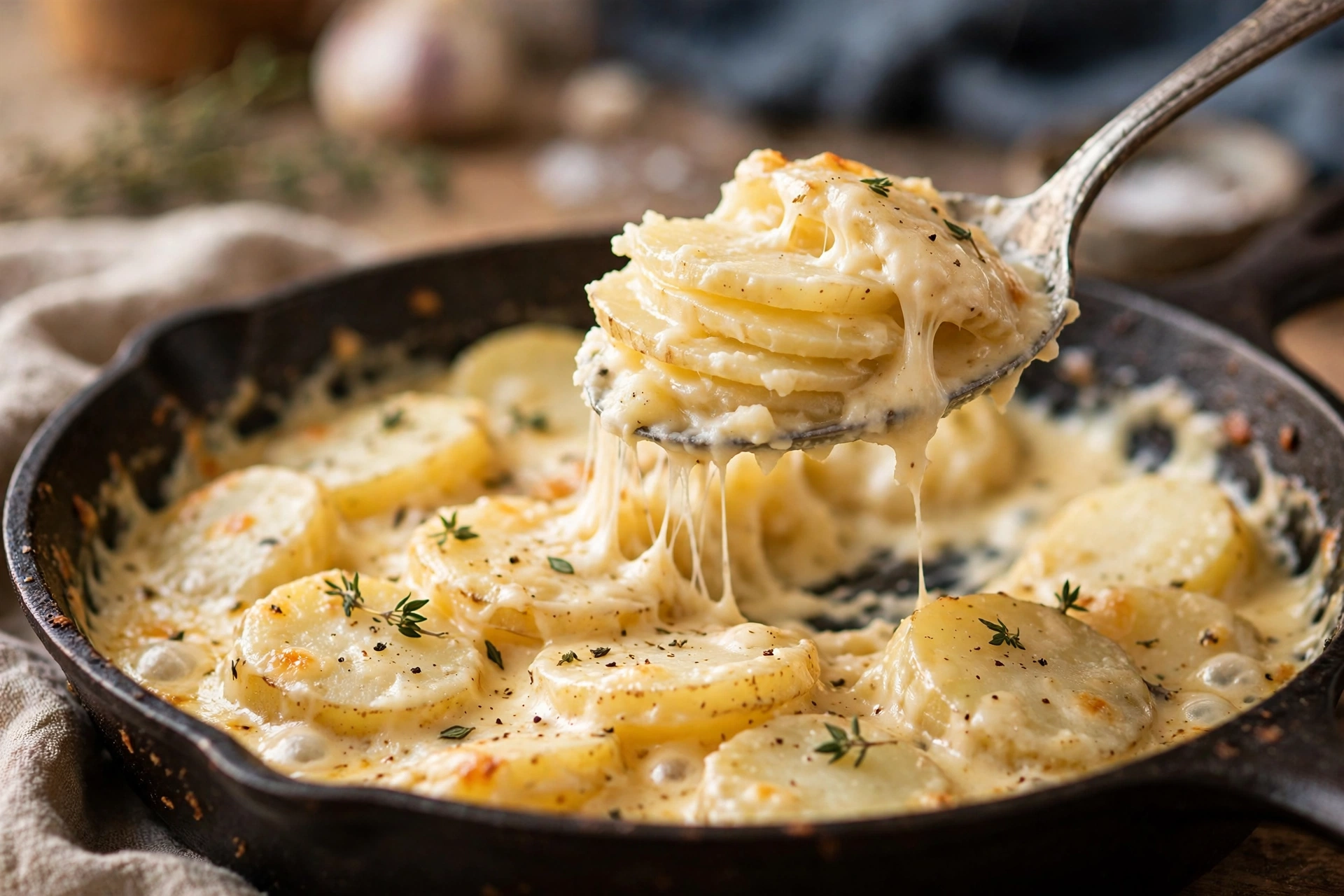
- Cheese and broil. Scatter the shredded cheese evenly over the top and slide the skillet under a hot broiler for 2 to 3 minutes, watching the whole time, until the top is golden with browned spots at the edges.
- Rest, then serve. Rest the pan off the heat for 5 minutes so the sauce sets into silk. Shower with chives and carry the whole skillet to the table. It was always meant to be served that way.
The Two Minute Broil That Fakes an Hour of Baking
The golden top on baked scalloped potatoes is not made by the long bake. It is made in the last stretch, when the surface dries and the cheese and cream brown against the heat. A broiler delivers that exact finish in two to three minutes, because it puts intense heat precisely where the color lives: on the surface. The potatoes below are already cooked by the simmer, so the broil is pure cosmetics, and cosmetics are fast.
Three rules keep it perfect. First, the skillet must be oven safe; choose cast iron or stainless over nonstick, since many nonstick coatings dislike broilers. Second, set the rack so the cheese sits about six inches from the element. Third, watch without walking away. The line between golden and scorched under a broiler is about forty seconds wide.
No broiler, or the broiler is busy with the rolls? Lid on, lowest heat, three minutes melts the cheese into a glossy blanket: paler, and still completely delicious.
Slice Thickness Versus Simmer Time
Pin this chart to the inside of a cabinet door, because it applies to every potato you will ever simmer in sauce.
- 1/16 inch, paper thin: 8 to 10 minutes. Very fast, but slices may break; best for a softer, almost melting pan.
- 1/8 inch, the recipe standard: 12 to 14 minutes. Tender with clean edges, the sweet spot.
- 1/4 inch, knife cut rustic: 18 to 22 minutes. Works, but the clock grows and the sauce reduces further; splash in an extra quarter cup of milk at the start.
- 1/2 inch chunks: not scalloped potatoes anymore. Simmer 25 plus minutes and call them what they are, a stew.
A Sauce That Never Breaks
Cream sauces get their bad reputation from two mistakes, both easy to dodge. The first is boiling: a hard boil throws hot cream against itself until the fat separates and the surface turns grainy. A covered low simmer never does this, which is why the recipe insists on lazy bubbles. The second is shock: cold liquid dumped into a ripping hot pan. Everything here warms together gently, so the sauce stays composed.
The flour does quiet structural work. Whisked raw into the cold liquids, it hydrates before it heats, so it cannot clump, and as the pan simmers it swells into the background body of the sauce. With the starch the potatoes release, you get a sauce that coats slices instead of pooling under them. If yours ever looks thin at the fork test, do not add flour to a hot pan: uncover for the last two minutes, then rest the full five. Evaporation plus resting thickens more gracefully than any rescue.
Richness is adjustable by ratio. All cream cloys by the third bite on a rich table; all milk runs thin. The cup and cup split, with broth for savor, is the balance that lets this sit next to gravy and still taste clean. Half and half instead of cream works too, with one warning: simmer even gentler, since lower fat sauces split more willingly.
Thanksgiving Clock: Hold, Reheat, Serve
Here is the schedule that makes this dish the easiest on the table. Start it when the turkey comes out to rest. The bird needs thirty to forty five minutes under foil; the potatoes need thirty minutes on a back burner. Simmer while the turkey rests, broil two minutes in the oven it just vacated, and both arrive hot at the same moment. This is the only side that uses the turkey rest as its cooking window.
Holding is forgiving. Cooked and rested, the skillet holds, covered, on the turned off burner for twenty minutes, and the sauce actually improves. Making it in the morning also works: simmer until just tender, cool, refrigerate in the skillet, then reheat covered over low heat with a splash of milk for eight to ten minutes and broil fresh. The top is always broiled at serving time; that part never moves.
On the table, it keeps the gravy honest. Round out the plate with our brown butter garlic mashed potatoes for the traditionalists, the green bean casserole for crunch and color, and the cranberry pecan wild rice pilaf for something bright and chewy. Two potato dishes is not excess at Thanksgiving. It is insurance.
Leftovers Worth Planning For
Refrigerated in a covered container, these keep four days, and the sauce protects the potatoes from the gray discoloration that ruins leftover plain potatoes. Reheat portions in a small skillet over low heat with a spoon of milk, covered, five minutes, and the edges crisp lightly against the pan in a way the microwave will never give you. The microwave works too at half power, just stir once halfway.
Leftovers have a second career at breakfast. Press a cold scoop flat in a hot buttered skillet until a crust forms, four minutes per side, and top it with a fried egg. It eats like the best hash brown of your life, and that trick alone justifies making the full pan for a small table.
Freezing is the one thing not to do: potatoes go grainy and the sauce separates on thawing. Double the recipe for the table instead. Potatoes, cooked and raw, also have a place in the vegetable guidance at MyPlate, a useful sanity check when a table gets very beige.
If your crew loves a one pan potato situation, the skillet broccoli cheese casserole uses the same burner logic with a crunchier finish, and the stovetop mac and cheese is the sister recipe for the sauce method. Master the gentle covered simmer and all three are yours.
Questions About These Stovetop Scalloped Potatoes
Can I make scalloped potatoes without cheese at all?
Yes, and you will be making the classic version. Skip the cheese and the broil, rest the pan five minutes, and finish with thyme leaves and a knob of butter melting over the top. The sauce carries the dish completely on its own.
Why did my sauce turn out thin?
Almost always one of two reasons: the slices were thick, so they released less starch in the simmer window, or the pan boiled instead of simmering. Next time, uncover only for the last two minutes, rest the full five off the heat, and check your thickness against the chart. The sauce thickens noticeably as it stands.
Can I use russet potatoes instead of Yukon Gold?
Yes. Peel them, since russet skins are tough, and expect a softer result: russets shed more starch, thicken the sauce faster, and break at the edges more easily. Simmer on the shorter end and handle the pan gently. The flavor is excellent either way.
How do I keep the potatoes from sticking to the skillet?
The butter at the start, a heavy pan, and the low simmer do the work together; the sauce under the first slices acts as a cushion. A well seasoned cast iron or a heavy stainless skillet is the reliable choice.
Can I add ham or other extras?
Small amounts of diced cooked ham folded between the layers is a classic move for the day after Thanksgiving version. Keep additions dry and modest, a cup at most, so the sauce balance and timing stay true. Raw meats do not belong here; they will not cook through in the simmer window.
Print
30-Minute Stovetop Scalloped Potatoes
Thin Yukon Gold slices simmered in a garlic thyme cream sauce in one skillet, crowned with a golden broiled cheese top. All the comfort of the baked classic in 30 minutes, with the oven left free for the turkey.
- Total Time: 30 minutes
- Yield: 8 servings 1x
Ingredients
- 2 1/2 pounds Yukon Gold potatoes, scrubbed and sliced 1/8 inch thick
- 2 tablespoons unsalted butter
- 1 small yellow onion, cut into thin half moons
- 2 cloves garlic, minced
- 2 tablespoons all-purpose flour
- 1 cup heavy cream
- 1 cup whole milk
- 1/2 cup low-sodium broth (chicken or vegetable)
- 1 teaspoon fresh thyme leaves (or 1/2 teaspoon dried)
- 1/8 teaspoon ground nutmeg
- 1 teaspoon kosher salt
- 1/2 teaspoon black pepper
- 1 cup shredded Gruyère or sharp white cheddar
- 1 tablespoon chopped chives
Instructions
- Slice the potatoes 1/8 inch thick with a mandoline and guard, or by knife. Slice the onion into thin half moons and mince the garlic.
- Melt the butter in a 12 inch oven safe skillet over medium heat. Cook the onion with a pinch of the salt for 3 minutes until soft. Add the garlic for 30 seconds.
- Whisk the flour into the cream, milk, and broth until smooth, then whisk in the remaining salt, pepper, thyme, and nutmeg. Pour into the skillet and bring to the barest simmer.
- Layer the potato slices into the sauce in overlapping handfuls, pressing gently until the liquid just peeks through the top layer.
- Cover and simmer on low for 12 to 14 minutes, keeping a lazy bubble, until a center slice bends and yields to a fork.
- Scatter the cheese over the top and broil 2 to 3 minutes, watching closely, until golden with browned edges.
- Rest off the heat for 5 minutes so the sauce sets. Top with chives and serve straight from the skillet.
- Prep Time: 10 minutes
- Cook Time: 20 minutes
Nutrition
- Serving Size: 1
- Calories: 310
- Sugar: 4
- Sodium: 420
- Fat: 17
- Saturated Fat: 10
- Unsaturated Fat: 6
- Trans Fat: 0
- Carbohydrates: 32
- Fiber: 3
- Protein: 7
- Cholesterol: 55