
In this article:
- Why This Peppermint Bark Holds Together When Others Split
- Dark, White, and a Cold Mint Snap
- The Barely Set Rule That Glues the Layers
- Seized Chocolate Is Not Dead Chocolate
- Ingredients for Peppermint Bark
- Melt, Freeze, Pour, Snap: The 20 Minute Run
- A Hot Knife Makes Gift-Worthy Shards
- Swaps: Darker, Salty, or Doubled Mint
- The Gift Box Timeline: Two Weeks, Three Weeks, Two Months
- A Full Tin of Christmas Candy in 20 Minutes
- FAQ
Why This Peppermint Bark Holds Together When Others Split
Peppermint bark fails in one famous way: the white layer lets go of the dark layer and the two slide apart in the tin. This version is built around stopping that split before it starts.
The fix is timing, not glue. The dark layer goes into the freezer only until it is barely set, still faintly tacky when a fingertip touches the corner. Lukewarm white chocolate poured over that surface bonds as both layers finish setting together.
Everything else serves the clock. The microwave works in 30 second bursts, the freezer does the setting in minutes instead of the fridge’s hour, and the candy canes are crushed in two sizes so the dust melts in while the shards stay loud.
There is no oven, no double boiler, and no thermometer. Twenty minutes after you start, the tray is setting for the last time and the knife is warming under the tap.
Peppermint bark is the Christmas candy I make when the cookie schedule has already eaten the whole day. It asks for a bowl, a spatula, and a corner of the freezer, nothing else.
The bite is the argument: a clean snap first, then dark chocolate, then the white layer melting sweet, then the cold little crunch of candy cane that keeps the whole thing from tasting flat.
It also travels like a champion. Stacked in a tin with parchment between the layers, it survives the trip to neighbors, teachers, and the office kitchen without a single smear.
Dark, White, and a Cold Mint Snap
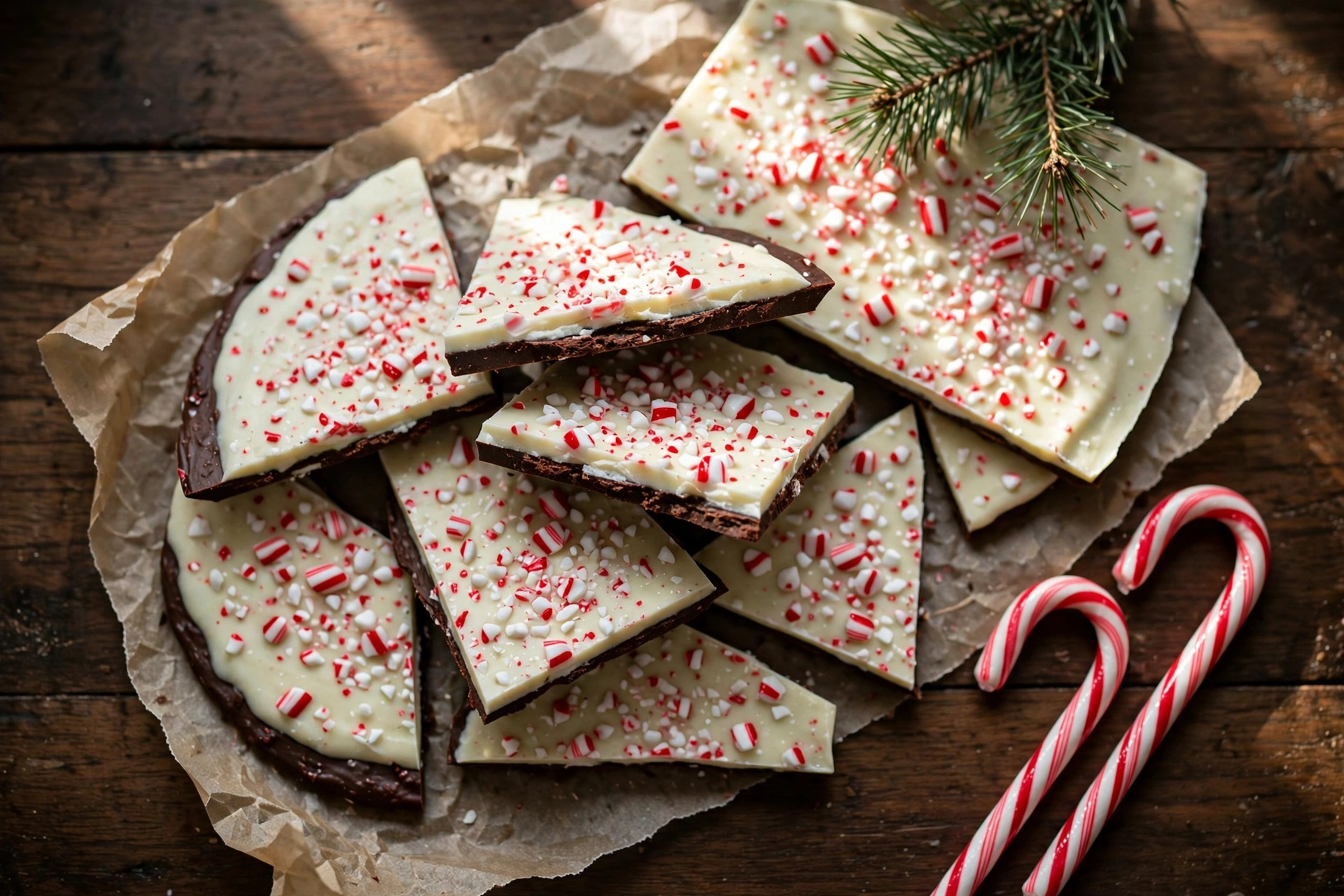
The dark layer is not a base, it is half the flavor. Semisweet chocolate brings the cocoa depth that keeps the bark tasting like candy for grown ups, not frosting.
White chocolate on top is the sweet, creamy counterweight. Poured thin, it reads as richness rather than sugar, and it gives the crushed cane a pale canvas to show against.
Peppermint extract goes into both layers in small doses, a quarter teaspoon each. The mint should arrive as a cool finish, never as toothpaste. The candy cane on top carries the louder mint note anyway.
Temperature is a flavor here. Served cool from the tin, the snap stays sharp and the mint tastes brighter. At warm room temperature the layers soften and the whole bite turns sweeter and slower.
A pinch of flaky salt on top is optional and quietly brilliant. It never makes the bark salty; it makes the chocolate taste more like chocolate.
Thickness quietly decides the eating experience. Spread the combined layers thinner than a quarter inch and the bark snaps like glass and melts fast. Go thicker and it eats like a candy bar, rich and slow. Neither is wrong, but the thin version is the one that disappears first from a mixed tin, so that is the version this recipe is written for.
The Barely Set Rule That Glues the Layers
Here is the whole secret, and it is worth slowing down for. Peppermint bark separates when the first layer is fully hard and cold before the second layer lands on it.
Cold, glassy chocolate gives warm chocolate nothing to hold. The top layer sets as its own sheet, and the first snap of a knife pops the two apart like a lid.
The fix is to pull the dark layer out early, when the surface has lost its wet shine but still takes a faint fingerprint at the edge. In a home freezer that is about 7 minutes.
The white chocolate matters just as much. It should be melted and fluid but only lukewarm, warm to a fingertip rather than hot. Poured too hot, it melts the dark layer into marbling; poured too cool, it drags and tears the surface.
Work the white layer quickly with an offset spatula, edge to edge, then get the candy cane on within a minute while the surface is still glossy and receptive.
This is the same logic that makes our 25-Minute Christmas Crack behave: a topping that lands at the right moment becomes part of the candy instead of a passenger on it.
Seized Chocolate Is Not Dead Chocolate
Chocolate seizes when water sneaks in or when the microwave bullies it. The smooth pool turns thick, grainy, and matte, and most cooks throw it out. Do not.
First, stop heating. Stir in one teaspoon of coconut oil or neutral oil, off the heat, and stir with patience. Most mild seizures smooth back out within a minute of steady stirring.
If it stays stubborn, stir in hot water one teaspoon at a time. It sounds backwards, but a seized mass is chocolate particles clumping around too little liquid; a spoonful more lets them slide again.
Prevention is simpler. Dry bowl, dry spatula, and bursts of 30 seconds with a stir between each. Stop while a few small lumps remain and let the residual heat finish the melt.
Chocolate choice counts too. A bar or chips that taste good eaten straight will make good bark; budget baking chips with heavy stabilizers melt dull and set soft. The ingredient list is short, so let the chocolate be the good stuff, the way we do in our 20-Minute Peppermint White Chocolate Fudge.
Ingredients for Peppermint Bark
- 12 ounces semisweet chocolate, chopped, or good quality chips
- 12 ounces white chocolate, chopped, or good quality chips
- 1/2 teaspoon peppermint extract, divided
- 1 teaspoon coconut oil, optional, for shine or rescue
- 1/2 cup crushed candy canes, about 6 standard canes, crushed in two sizes
- Pinch of flaky sea salt, optional
Everything on this list is a pantry regular in December, and the whole recipe lives in our desserts collection alongside the season’s other fast sweets.
Melt, Freeze, Pour, Snap: The 20 Minute Run
- Line a rimmed baking sheet with parchment paper. Put the candy canes in a zip bag and crush them with a rolling pin, keeping a mix of fine dust and small shards. Set aside.
- Add the semisweet chocolate to a dry microwave safe bowl. Microwave in 30 second bursts, stirring well after each, stopping while a few small lumps remain. Stir until fully smooth, then stir in 1/4 teaspoon peppermint extract.
- Pour the dark chocolate onto the parchment and spread it into an even layer about 1/4 inch thick. Slide the tray into the freezer for about 7 minutes, until the surface looks matte at the edges but still feels faintly tacky in the center.
- While the dark layer sets, melt the white chocolate the same way, in 30 second bursts in a clean dry bowl. Stir in the remaining 1/4 teaspoon peppermint extract and let it cool 2 minutes so it is lukewarm, not hot.
- Pour the white chocolate over the barely set dark layer and spread it gently edge to edge. Scatter the crushed candy canes over the whole surface at once, dust and shards together, and press very lightly with a clean palm.
- Return the tray to the freezer for 5 minutes, then let it stand at room temperature for 5 minutes so it cuts without shattering.
- Run a large knife under hot water, dry it, and cut the slab into shards, or break it by hand along loose score lines. Finish with the flaky salt if using.
A Hot Knife Makes Gift-Worthy Shards
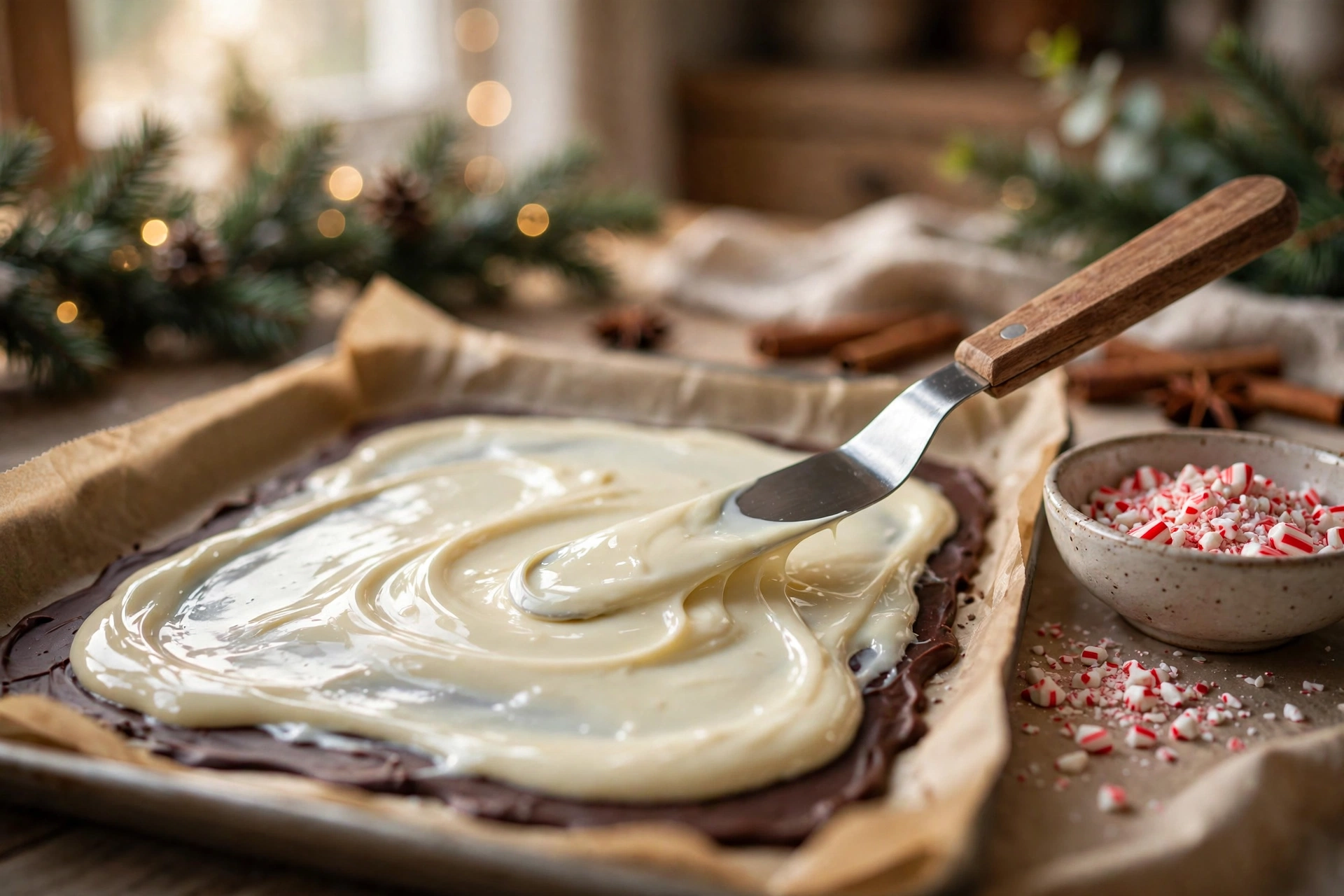
Breaking bark by hand is charming and chaotic. Half the slab ends as crumbs, and the biggest pieces look like rubble. A hot knife changes the whole presentation.
Hold the blade under hot tap water for 10 seconds, dry it completely, and press straight down. The warm edge melts a hairline path through both layers, so the cut stays clean and the layers stay married.
Reheat and dry the knife every two or three cuts. Wet chocolate is seized chocolate’s cousin, so the drying step is not optional.
Cut diamonds or rough rectangles for tins, and save the small broken bits. Those crumbs are the cook’s tax and the best topping for vanilla ice cream in December.
For a party platter instead of gifts, skip the knife and go rustic, the way we serve the 15-Minute White Chocolate Peppermint Popcorn alongside it. The two together cover every texture a dessert table wants.
Swaps: Darker, Salty, or Doubled Mint
Go darker by swapping the semisweet layer for 70 percent dark chocolate. The bark turns more intense and less sweet, and the flaky salt on top becomes nearly mandatory.
Go the other way with a milk chocolate base for younger palates. Keep the white layer and the cane exactly the same so the bark still reads as classic.
Doubled mint means an extra 1/4 teaspoon of extract in the white layer plus finely crushed cane folded into it before spreading. It eats colder and louder, which some households consider the whole point.
A thin smear of crushed freeze dried raspberries over half the tray gives a pink, tart corner for anyone who finds straight peppermint one note. It looks beautiful in a mixed tin.
And if candy canes have vanished from the stores by mid December, round peppermint candies crush exactly the same. Nobody at the table will ever know.
One more worth knowing: a quarter teaspoon of espresso powder stirred into the dark layer deepens the chocolate without a trace of coffee flavor. It is the variation adults ask about, usually while reaching for a second piece.
The Gift Box Timeline: Two Weeks, Three Weeks, Two Months
At room temperature in a sealed tin with parchment between layers, the bark keeps its snap for about 2 weeks. Keep the tin cool and dark; chocolate absorbs nearby odors happily.
In the fridge it keeps 3 weeks, though the surface can pick up a faint condensation bloom when it comes back out. Let the tin warm up closed for 20 minutes before opening.
Frozen, in a sealed bag with the air pressed out, it keeps 2 months. Thaw it still sealed, again so condensation lands on the bag and not the bark.
For gifts, pack tins within the first week so recipients get the loudest snap. A small card noting the make date is a thoughtful touch borrowed from bakery boxes.
One caution for warm kitchens: if your December kitchen runs hot, default to the fridge from day one. Chocolate that softens and resets repeatedly loses its temper and its snap, and no storage timeline survives that cycle.
Storage numbers like these come from plain food science: chocolate keeps best cool, dry, and sealed, the same guidance behind the USDA listings for chocolate and candy in USDA FoodData Central.
A Full Tin of Christmas Candy in 20 Minutes
Peppermint bark done this way asks for 20 minutes, a bowl, and a patch of freezer, and it pays back a full tin of Christmas candy that holds together to the last shard.
The barely set rule is the whole recipe. Once your hands know that tacky surface, you will never lose a white layer again, in this recipe or any layered candy.
Make it next to a mug of something warm, ideally our 20-Minute Hot Chocolate Bombs doing their slow melt in the cup.
Happy cooking, and may your layers never part. Hanna
FAQ
Why do the layers of my peppermint bark separate?
The dark layer was fully hard and cold when the white layer went on, so the two set as separate sheets. Pull the dark layer while it is barely set and faintly tacky, and pour the white chocolate lukewarm so the two layers finish setting as one.
My chocolate seized in the microwave. Can I still make peppermint bark?
Usually, yes. Stop heating, then stir in 1 teaspoon of coconut oil and stir steadily for a minute. If it stays grainy, add hot water 1 teaspoon at a time until it loosens. Next time, use a bone dry bowl and 30 second bursts. Your peppermint bark will still set up glossy.
Should I use candy melts or real chocolate for peppermint bark?
Real chocolate, every time. Candy melts set hard but taste waxy and melt dull, while a semisweet and white chocolate you would happily eat plain give this peppermint bark its snap and flavor. With only six ingredients, the chocolate is the recipe.
How far ahead can I make peppermint bark for gifts?
Make this peppermint bark up to 2 weeks ahead and store it in a sealed tin at cool room temperature with parchment between the layers. For longer storage, the fridge gives you 3 weeks and the freezer 2 months, thawed still sealed.
Can I use peppermint candies instead of candy canes?
Yes. Round peppermint candies crush exactly like canes and taste the same in peppermint bark. Crush a mix of fine dust and small shards: the dust melts into the white chocolate for flavor everywhere, and the shards keep the crunch on top.
Peppermint Bark
Peppermint bark in 20 minutes with two clean layers that never separate: semisweet and white chocolate melted in 30 second bursts, a barely set dark layer, lukewarm white chocolate poured over, and candy canes crushed in two sizes on top. No oven, no double boiler.
- Total Time: 20 minutes
- Yield: 30 pieces 1x
Ingredients
- 12 ounces semisweet chocolate, chopped, or good quality chips
- 12 ounces white chocolate, chopped, or good quality chips
- 1/2 teaspoon peppermint extract, divided
- 1 teaspoon coconut oil, optional, for shine or rescue
- 1/2 cup crushed candy canes, about 6 standard canes, crushed in two sizes
- Pinch of flaky sea salt, optional
Instructions
- Line a rimmed baking sheet with parchment paper. Put the candy canes in a zip bag and crush them with a rolling pin, keeping a mix of fine dust and small shards.
- Add the semisweet chocolate to a dry microwave safe bowl. Microwave in 30 second bursts, stirring well after each, stopping while a few small lumps remain. Stir until fully smooth, then stir in 1/4 teaspoon peppermint extract.
- Pour the dark chocolate onto the parchment and spread it into an even layer about 1/4 inch thick. Freeze for about 7 minutes, until matte at the edges but still faintly tacky in the center.
- Melt the white chocolate the same way in a clean dry bowl. Stir in the remaining 1/4 teaspoon peppermint extract and let it cool 2 minutes so it is lukewarm, not hot.
- Pour the white chocolate over the barely set dark layer and spread gently edge to edge. Scatter the crushed candy canes over the whole surface and press very lightly with a clean palm.
- Return the tray to the freezer for 5 minutes, then let it stand at room temperature for 5 minutes.
- Run a large knife under hot water, dry it, and cut the slab into shards. Finish with flaky salt if using.
- Prep Time: 12 minutes
- Cook Time: 8 minutes
1 commentaire sur « 20-Minute Peppermint Bark (Two Layers, Zero Baking) »