
In this article:
- Warm Milk and Molasses Do the Heavy Lifting
- Ginger Leads, Cinnamon Warms, Cloves Whisper
- The Christmas Eve Dry Mix, the Christmas Morning Payoff
- Ingredients for Gingerbread Pancakes
- Mixing, Resting and Griddling the Gingerbread Pancakes
- Three-Minute Ginger Maple Syrup While the First Batch Cooks
- Dark Bottoms, Gummy Centers and Batter That Thickens, Fixed
- Dairy Free Bowls, Applesauce Swaps and a Pumpkin Spice Cousin
- A Lighter Stack: Part Whole Wheat and a Yogurt Cloud
- Freeze Them Flat, Toast Them Back to Christmas
- Warm Stacks, Cold Morning, Nobody Waiting
- Gingerbread Pancake Questions, Answered
Warm Milk and Molasses Do the Heavy Lifting
Gingerbread pancakes fail in two predictable ways: the spice tastes dusty, or the molasses turns the whole stack bitter. Warm milk fixes the first by blooming the ground spices before they ever meet flour, and ordinary mild molasses, never blackstrap, fixes the second.
The batter is built like a spice cake that happens to cook on a griddle. Molasses brings the deep, almost smoky sweetness, brown sugar rounds the edges, and the baking soda reacts with the molasses acidity to lift the crumb into something tall and tender.
Resting is not dead time in this recipe. Five minutes of rest hydrates the flour so the centers cook through instead of staying gummy, and those five minutes are exactly the time the griddle needs to heat. Nothing waits on anything else.
The last quiet trick is portion discipline. A level quarter cup per pancake gives eight even rounds that finish together, stack neatly and reheat like a matched set instead of a pile of odds and ends.
Gingerbread pancakes are what Christmas morning smells like at my house before anyone is fully awake: warm spice, hot butter and maple, drifting up the stairs ahead of the coffee. The first stack lands while the stockings are still being argued over.
The pancakes themselves are deep amber, softer than a sugar cookie and warmer in flavor, with edges that go faintly crisp on the griddle. A fork cuts through two layers without any fight, and the crumb stays moist enough to skip the syrup, though nobody ever does.
They also behave like a recipe that respects the morning. Twenty minutes from bowl to table, one bowl for dry, one for wet, and a griddle that never asks for more than medium heat and a watchful eye.
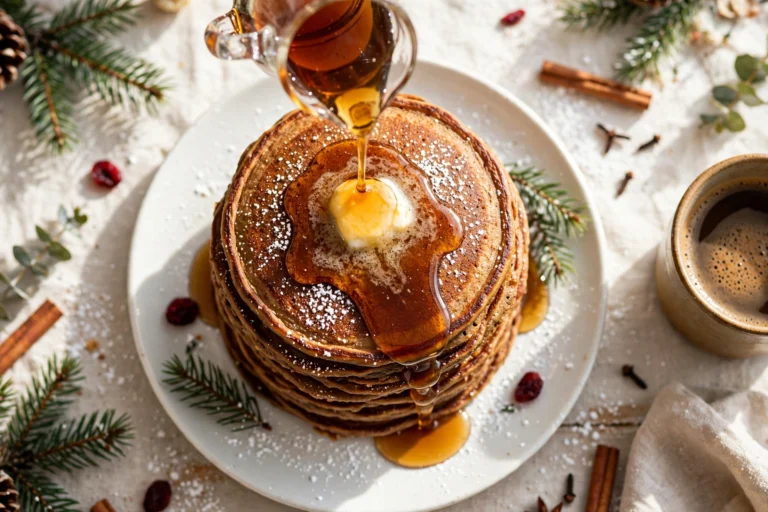
Ginger Leads, Cinnamon Warms, Cloves Whisper
Ground ginger is the voice of this batter at two full teaspoons, enough to register as warmth at the back of the tongue without turning medicinal. Cinnamon supports it at a teaspoon and a half, sweet and woody, the flavor most people actually name first.
Cloves and nutmeg work in quarter teaspoons, and that restraint is the whole point. Cloves go from festive to antiseptic in a single heavy shake, so they season the background while ginger and cinnamon carry the tune.
Texture matters as much as spice. The crumb should be plush, never bready, with a fine, even grain and surfaces that take butter in glossy pools. If your pancakes bend like bread slices, the batter was overmixed, not undercooked.
Served hot, the spice blooms with the steam. Served five minutes later, the molasses deepens and the stack tastes more like the cookie that inspired it, which is why leftovers at noon are a cook’s private bonus.
The Christmas Eve Dry Mix, the Christmas Morning Payoff
Measure everything dry into one bowl on Christmas Eve: flour, leaveners, salt, sugar and every spice. Cover the bowl and leave it on the counter. In the morning you add warm milk, egg, molasses and butter, and breakfast is fifteen minutes away.
Do not mix the wet batter the night before. Baking soda starts spending itself the moment it meets the molasses, and a batter that sleeps overnight rises sadly and cooks up flat. The dry mix waits patiently; the wet batter does not.
The morning sequence runs itself. Milk warms, batter rests, griddle heats, syrup simmers, and the first four pancakes cook while the house is still deciding who makes coffee. Every step uses the waiting time of the step before it.
If your Christmas morning runs on a bigger crowd, the dry mix doubles cleanly in a bigger bowl. Keep the quarter cup measure and cook in relays, holding finished pancakes in a low oven as described below.
Ingredients for Gingerbread Pancakes
- 1 1/2 cups all-purpose flour
- 2 teaspoons baking powder
- 1/2 teaspoon baking soda
- 1/2 teaspoon fine sea salt
- 2 teaspoons ground ginger
- 1 1/2 teaspoons ground cinnamon
- 1/4 teaspoon ground cloves
- 1/4 teaspoon ground nutmeg
- 2 tablespoons packed brown sugar
- 1 1/4 cups whole milk, warmed until steaming
- 1 large egg, at room temperature
- 1/4 cup unsulfured molasses (not blackstrap)
- 3 tablespoons butter, melted, plus more for the griddle
- 1 teaspoon vanilla extract
- 1/2 cup pure maple syrup, for the ginger syrup
- 1/4 teaspoon ground ginger, for the syrup
- Powdered sugar and extra butter, for serving
On molasses, the label matters more than the brand. You want the jar that simply says molasses, the mild baking kind used for cookies. Blackstrap is a different product, mineral heavy and bitter, and it will bully every other flavor in the bowl.
Room temperature egg and warm milk are not fussy details here. Cold wet ingredients chill the melted butter into little solid flecks, and those flecks become uneven pockets in the crumb instead of richness spread through every bite.
Mixing, Resting and Griddling the Gingerbread Pancakes
- Whisk the flour, baking powder, baking soda, salt, ginger, cinnamon, cloves, nutmeg and brown sugar in a large bowl until the spices are evenly freckled through the flour. This bowl can be covered and left overnight.
- Whisk the warm milk, egg, molasses, melted butter and vanilla in a second bowl until the molasses disappears into the milk and the mixture looks like pale caramel.
- Pour the wet mixture into the dry and stir with a spatula just until no dry flour remains, about 12 strokes. Lumps are welcome; a smooth batter is an overmixed one. Rest the batter for 5 minutes.
- While the batter rests, heat a griddle or large skillet over medium heat. Flick on a few drops of water: they should dance and evaporate in about 2 seconds. Brush the surface lightly with butter.
- Scoop a level 1/4 cup of batter per pancake, leaving room to spread. Cook until the surfaces are covered with bubbles that begin to pop and the edges look set, about 2 minutes.
- Flip once, confidently, and cook 1 to 2 minutes more, until the second side is deep golden and the center springs back when pressed lightly. Never pat a pancake down with the spatula.
- Move finished pancakes to a plate in a 200°F oven, uncovered, while you cook the second batch. Rebutter the griddle lightly between batches.
- Warm the maple syrup with the 1/4 teaspoon of ginger in a small saucepan for 2 to 3 minutes, just until steaming. Serve the stacks hot with butter, the ginger syrup and a snowfall of powdered sugar.
These gingerbread pancakes reward a cook who watches the first one like a scout. It tells you if the griddle runs hot, if the batter needs a spoon of milk, and exactly how your stove times the flip.
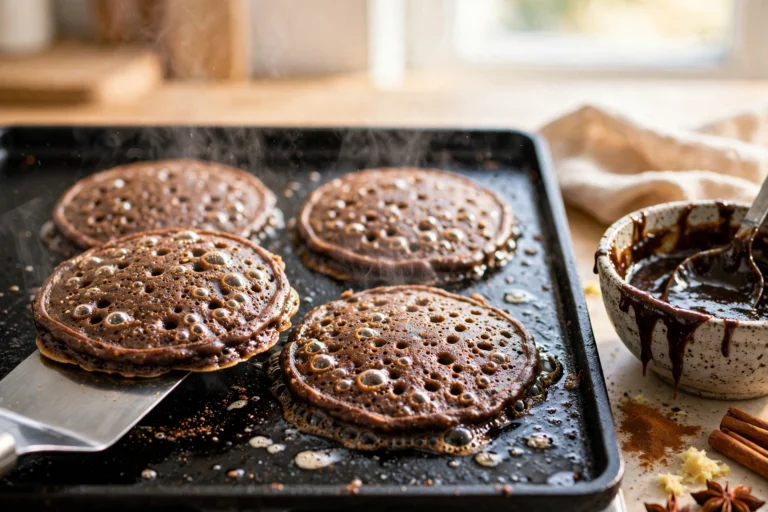
Three-Minute Ginger Maple Syrup While the First Batch Cooks
Plain maple syrup is fine on these pancakes, but a whisper of ginger in the syrup doubles the gingerbread effect without touching the batter. Warm half a cup of syrup with a quarter teaspoon of ground ginger until it steams, about 3 minutes, and keep it warm.
The syrup also solves a serving problem. Cold syrup on hot pancakes drags the whole stack down ten degrees in one pour. Warm syrup keeps the butter melting and the spice fragrant all the way to the last bite.
Leftover syrup keeps two weeks in the fridge in a small jar. It is quietly excellent on oatmeal, in hot tea, and over the vanilla ice cream that appears after holiday dinners.
Dark Bottoms, Gummy Centers and Batter That Thickens, Fixed
Dark bottoms with pale tops mean the griddle is too hot, full stop. Molasses and brown sugar caramelize faster than plain batter, so this recipe lives at honest medium heat, a notch below where you cook plain pancakes.
Gummy centers come from two causes: batter that skipped its rest, or pancakes flipped by the clock instead of by the bubbles. The surface should look set at the edges and bubbled across the middle before any flip is attempted.
If the batter thickens heavily while it rests, which strong flour can cause, whisk in warm milk one tablespoon at a time until it falls off the scoop in a slow ribbon. Thick batter spreads into tall, undercooked middles.
Pancakes that spread into thin crepes tell the opposite story: too much liquid, or baking powder past its prime. Test old powder in hot water first; it should fizz with conviction.
Dairy Free Bowls, Applesauce Swaps and a Pumpkin Spice Cousin
For a dairy free stack, swap the whole milk for oat milk and the butter for melted coconut oil, keeping every measure identical. Oat milk browns a shade faster, so watch the first batch and pull the heat down if needed.
Unsweetened applesauce can replace half the butter when the jar is nearly empty. The crumb stays tender, the flavor leans fruitier, and the tops will look a little less glossy, which powdered sugar corrects instantly.
The pumpkin spice cousin uses the same skeleton: trade the ginger, cloves and nutmeg for two teaspoons of pumpkin pie spice and add two tablespoons of pumpkin puree to the wet bowl. Same griddle, same timing, completely different December mood.
On mornings when the house votes for a different kind of festive, our 15-minute eggnog pancakes take the same griddle in the opposite direction, all nutmeg and cream, while these stay dark and spiced.
A Lighter Stack: Part Whole Wheat and a Yogurt Cloud
Swap half a cup of the flour for white whole wheat flour and the stack gains a gentle nuttiness with no toughness. Going fully whole wheat makes the pancakes hearty but heavy, which fights the holiday mood.
A spoonful of Greek yogurt whipped with a pinch of cinnamon replaces whipped cream at the table with the same white contrast against the amber crumb. It also adds protein to a breakfast that otherwise runs on celebration.
Portion is the quietest lever of all. Serve one pancake beside scrambled eggs and fruit for the small eaters, and let the tall stack belong to the people who will shovel the driveway afterward.
Freeze Them Flat, Toast Them Back to Christmas
Cool leftover pancakes completely, stack them between small squares of parchment, and freeze in a bag for up to 2 months. The parchment matters: frozen pancakes stacked bare will weld into a single spiced brick.
Reheat from frozen in the toaster on a medium setting, two cycles if your toaster runs cool. The edges crisp again, the centers steam back to softness, and nobody can tell they were not griddled that morning.
Fridge storage is simpler but shorter: 3 days, sealed, reheated in a dry skillet for a minute a side. For the full Christmas morning spread beside them, our Christmas breakfast quesadillas bring the savory half of the table in the same half hour.
Our numbers, per serving of two pancakes with a tablespoon of ginger syrup: about 365 calories, 58 g carbohydrates, 24 g sugar, 11 g fat, 8 g protein and 470 mg sodium. For reference, USDA FoodData Central lists a tablespoon of molasses at roughly 60 calories with a useful dose of iron for a sweetener.
Warm Stacks, Cold Morning, Nobody Waiting
Gingerbread pancakes earn their place on the busiest morning of the year by refusing to be busy themselves: a bowl mixed the night before, five honest minutes of rest, and a griddle that does the rest while the house wakes up.
Double the dry mix in a jar with a ribbon and it becomes the gift jar teachers actually use, with the wet ingredients and griddle times written on the tag. It is the rare homemade gift that costs less than the ribbon.
Make the first pancake small, taste it standing at the stove, and adjust the ginger in the syrup accordingly. That first bite is the cook’s, and it has always been the best one. Hanna
Gingerbread Pancake Questions, Answered
Can I use blackstrap molasses for gingerbread pancakes?
It is not recommended. Blackstrap is the third boiling of the cane and tastes bitter and mineral heavy, which overwhelms the spices. Ordinary unsulfured baking molasses gives the deep color and rounded sweetness this recipe is built on.
Why does the batter need to rest for 5 minutes?
The rest hydrates the flour so the centers cook through instead of staying gummy, and it lets the baking powder begin its lift. Five minutes is enough here, and the griddle heats during the same window, so no time is lost.
Can I mix the whole batter the night before?
Keep the dry mix overnight, but add the wet ingredients in the morning. Baking soda starts reacting with the molasses as soon as they meet, and a batter that sleeps all night cooks up flat and dense.
My pancakes brown too fast on the bottom. What is wrong?
Molasses and brown sugar caramelize quicker than plain batter, so the griddle is almost certainly too hot. Cook at honest medium heat, and use the water drop test: drops should dance for about 2 seconds before evaporating.
Can I make these on a skillet instead of a griddle?
Yes, a large nonstick or cast iron skillet works well. Cook two pancakes at a time instead of four, keep the finished ones warm in a 200°F oven, and wipe the pan lightly with butter between batches.
Gingerbread Pancakes
Gingerbread pancakes in 20 minutes: warm milk blooms the ginger, cinnamon and cloves, mild molasses keeps the crumb dark and tender, and a three-minute ginger maple syrup goes over the top. The dry mix is measured on Christmas Eve, so Christmas morning is only a griddle away.
- Total Time: 20 minutes
- Yield: 8 pancakes 1x
Ingredients
- 1 1/2 cups all-purpose flour
- 2 teaspoons baking powder
- 1/2 teaspoon baking soda
- 1/2 teaspoon fine sea salt
- 2 teaspoons ground ginger
- 1 1/2 teaspoons ground cinnamon
- 1/4 teaspoon ground cloves
- 1/4 teaspoon ground nutmeg
- 2 tablespoons packed brown sugar
- 1 1/4 cups whole milk, warmed until steaming
- 1 large egg, at room temperature
- 1/4 cup unsulfured molasses (not blackstrap)
- 3 tablespoons butter, melted, plus more for the griddle
- 1 teaspoon vanilla extract
- 1/2 cup pure maple syrup, for the ginger syrup
- 1/4 teaspoon ground ginger, for the syrup
- Powdered sugar and extra butter, for serving
Instructions
- Whisk the flour, baking powder, baking soda, salt, ginger, cinnamon, cloves, nutmeg and brown sugar in a large bowl until the spices are evenly freckled through the flour. This bowl can be covered and left overnight.
- Whisk the warm milk, egg, molasses, melted butter and vanilla in a second bowl until the molasses disappears into the milk and the mixture looks like pale caramel.
- Pour the wet mixture into the dry and stir with a spatula just until no dry flour remains, about 12 strokes. Lumps are welcome; a smooth batter is an overmixed one. Rest the batter for 5 minutes.
- While the batter rests, heat a griddle or large skillet over medium heat. Flick on a few drops of water: they should dance and evaporate in about 2 seconds. Brush the surface lightly with butter.
- Scoop a level 1/4 cup of batter per pancake, leaving room to spread. Cook until the surfaces are covered with bubbles that begin to pop and the edges look set, about 2 minutes.
- Flip once, confidently, and cook 1 to 2 minutes more, until the second side is deep golden and the center springs back when pressed lightly. Never pat a pancake down with the spatula.
- Move finished pancakes to a plate in a 200°F oven, uncovered, while you cook the second batch. Rebutter the griddle lightly between batches.
- Warm the maple syrup with the 1/4 teaspoon of ginger in a small saucepan for 2 to 3 minutes, just until steaming. Serve the stacks hot with butter, the ginger syrup and a snowfall of powdered sugar.
Notes
Two rules carry this recipe: ordinary unsulfured molasses, never blackstrap, and the 5 minute rest taken while the griddle heats, so no time is wasted. The dry mix waits overnight happily; the wet batter does not, because the baking soda starts spending itself on contact with the molasses. Leftovers freeze flat between parchment for up to 2 months and toast back perfectly. Nutrition per serving of 2 pancakes with a tablespoon of ginger syrup: about 365 calories, 58 g carbohydrates, 24 g sugar, 11 g fat, 8 g protein, 470 mg sodium.
- Prep Time: 8 minutes
- Cook Time: 12 minutes
- Category: Breakfast
- Method: Griddle
- Cuisine: American